Expanded wiki for video, partners and resort/utility negotiations — with anchored sections:
- Watch: Jellyfish Acoustics — short film (English)
- Statocysts — how a jellyfish "hears" with its body
- Storms and infrasound — depth-diving hypothesis
- Problem coastlines — Tier A/B/C region table
- 🇮🇱 Israel — desal, 2019 intake, water security
- 🇦🇺 Australia — box jellyfish, Irukandji, stinger season
- Jellyfish vs nuclear & desal — Oskarshamn, Torness, Shimane…
- Acoustics — measured vs R&D
- HERD: barrier + network — nodes, drone, boat
- 196 sources — full bibliography
Film · English
Jellyfish Acoustics
How jellyfish sense low-frequency sound, why blooms clog desal plants and beaches, and HERD’s idea of a gentle acoustic corridor — in plain language. Full wiki with 196 sources below.
Why this at all
A problem that hurts to touch with bare hands
Jellyfish blooms are not just a ruined holiday and stings on the beaches of Phuket. Jellyfish swarms clog the water intakes of power plants and desalination plants around the world, forcing reactors and pumps to shut down. Today's solutions are crude: nets, bubble curtains, mechanical shredders and netting them out by hand5. They either work poorly or simply kill the animal.
We are a low-frequency acoustics lab. And we have a counter-question: what if jellyfish can be politely asked to swim away?
Why this isn't science fiction
The science: jellyfish "hear" with their bodies
A jellyfish has no brain and no ears, but around the rim of the bell sit statocysts (in the rhopalia) — tiny balance organs with sensitive hair cells. With these, a jellyfish is thought to pick up the low-frequency rumble of an approaching storm and move to deeper water in advance.
This is not just folk observation. A study by Solé et al. (2016, Scientific Reports) showed that after exposure to low-frequency sound, the Mediterranean jellyfish Cotylorhiza tuberculata and Rhizostoma pulmo developed damage to the hair cells in the sensory epithelium of the statocyst1. The conclusion cuts both ways: jellyfish are genuinely sensitive to low-frequency sound — but strong sound injures them. Engineers, in fact, respect the sensitivity of their "otoliths" to ultra-low frequencies so much that they copy it in bio-inspired underwater vector hydrophones2.
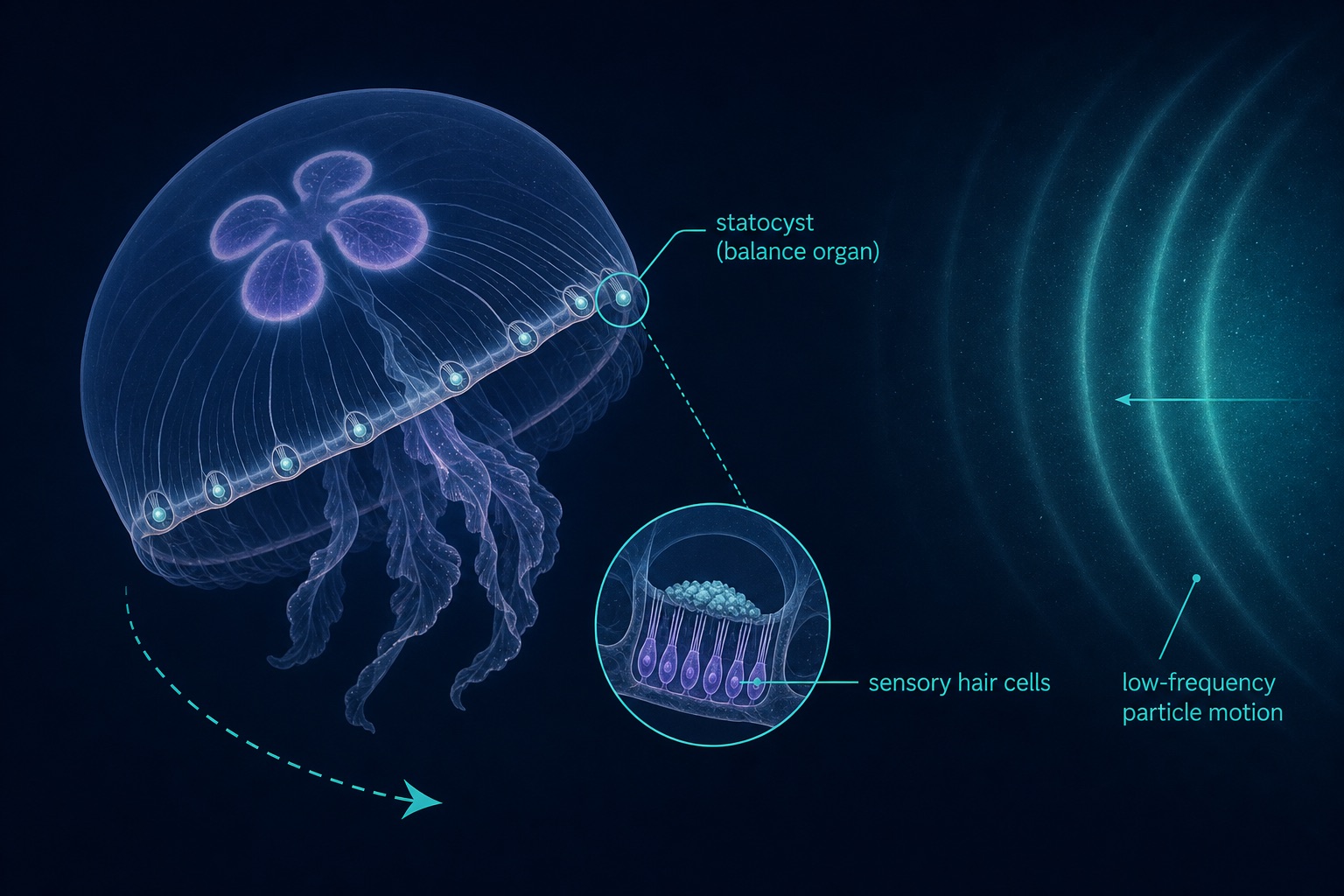
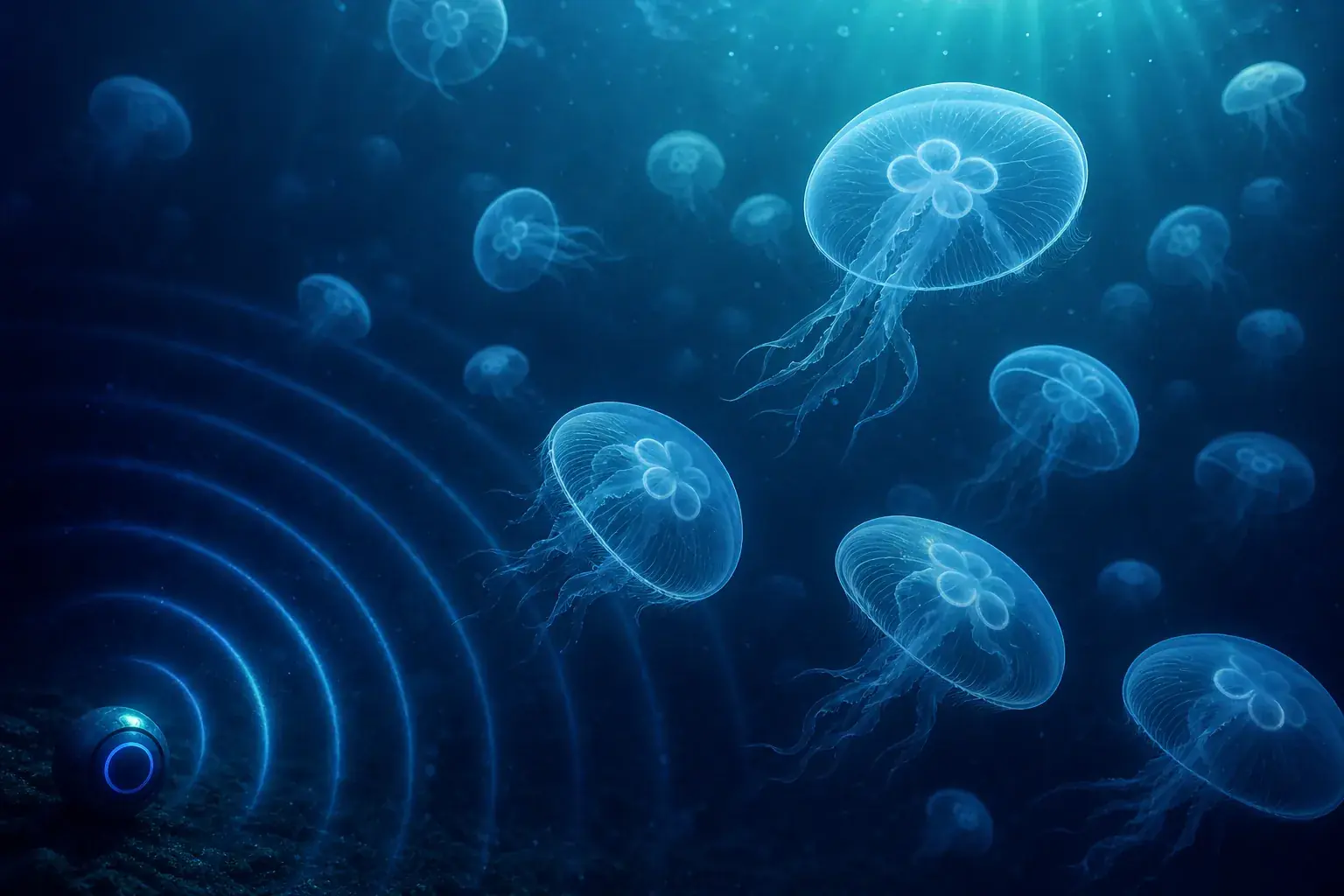
Measured: sound at 50–400 Hz (157 dB re 1 µPa, 2 hours) damages statocyst hair cells — the tissue is clearly not indifferent to sound (Solé et al., 2016). Not measured: a hearing threshold — no jellyfish audiogram exists; and avoidance — nobody watched whether the animal swam away. So "proven hearing" would claim more than the data allow. Plus the physics: a statocyst senses water particle motion, not pressure, so "pressure decibels" is the wrong unit for a jellyfish. And separately, reliable "prediction of storms and earthquakes by animals" is not supported by rigorous reviews (Woith et al., 2018)6. Our R&D rests on the measured tissue sensitivity and a testable hypothesis.
Precedent
Sound is already used to drive animals away — but fish
Acoustic "fences" are a working technology for fish that hear well. At a power-plant water intake, sound at 20–600 Hz cut fish intake by 60% on average, and for herring and sprat by 88–95%3. Infrasound drives off eels4, and at one nuclear plant's cooling intake an infrasound system gave up to 80% reduction in cyprinid intake4. Under UK norms such installations work in the 10 Hz – 3 kHz band.
For jellyfish, acoustic deterrence is not yet proven. Reviews of water intakes list bubble curtains and mechanical removal as working methods, and call acoustics for jellyfish preliminary5. We do not promise a finished device. We state a hypothesis and go test it — like the whole HERD project.
Ethics first
The principle: steer away, do not maim
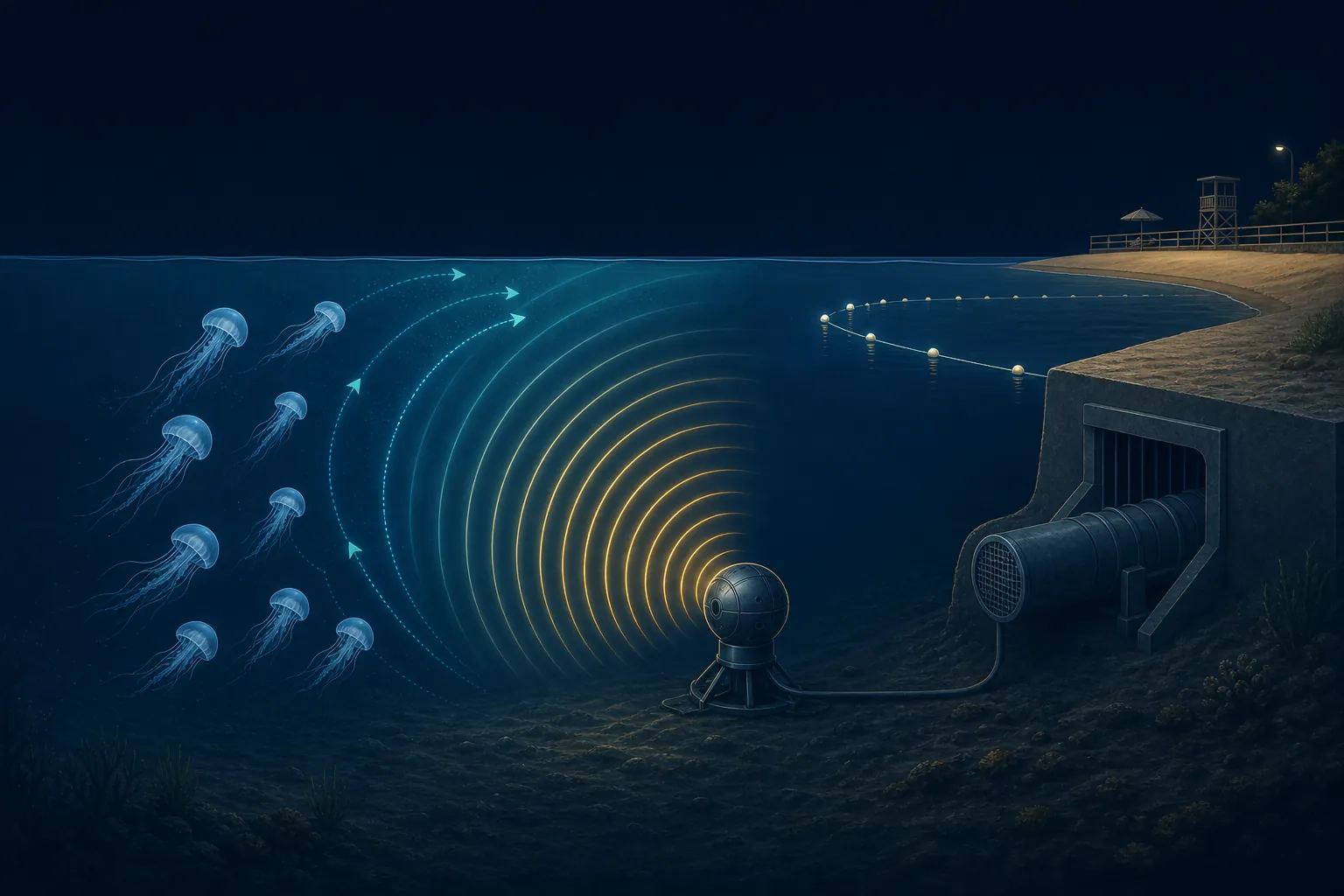
Solé showed where the line is: loud low-frequency sound tears the hair cells of the statocyst. So the key engineering question is to find a "polite" regime: noticeable enough for the jellyfish to change course, and gentle enough not to cause acoustic injury. Not a weapon, but a soft barrier. That is what separates a "humane deterrent" from brute force.
What exactly we test
Hypothesis and research questions
There exists a band of frequencies and sound levels at which jellyfish consistently change their direction of travel with no signs of statocyst damage.
From it grow concrete questions:
- Which frequencies cause avoidance rather than indifference? (the starting zone of interest is single to tens of Hz)
- Where is the injury threshold by level/exposure time — and how far below it is the "polite" regime?
- How does the response differ across species (Aurelia / Rhizostoma / box jellyfish)?
- Does an acoustic gradient work as a directional barrier, not just a scarecrow?
- Do jellyfish habituate — and how do we avoid it by varying the signal?
How we'll do it
A phased experiment plan
Tank and calibration
An underwater low-frequency emitter + hydrophone in a controlled volume. We calibrate the field and measure the background. The airborne reference is checked against our reference infrasound monitor.
Frequency sweeps and tracking
We run frequency sweeps at low levels and use video tracking to count the share of individuals that change course. We look for the "avoidance window" at minimum power.
Confirming no injury
Following Solé's method (SEM inspection of the statocyst) we verify that the "polite" regime does not damage the sensory epithelium. Without this step the product is impossible.
A barrier in a bay / at an intake
A small pilot: an acoustic gradient at the entrance of a bathing zone or intake. The metric — reduced swarm entry with confirmed safety.
The starter kit is an underwater spherical projector/hydrophone for the ~10 Hz–1 kHz band (Chinese manufacturers do supply these to order) and an airborne reference infrasound monitor. Heavy infrasound generators come later, for a fixed lab.
Patents & IP
Our method is patent pending
HERD's humane jellyfish-deterrence R&D is the subject of two US provisional patent applications: an acoustic low-frequency method (App No. 64/111,305, filed 14 July 2026) and an optical / visual method (App No. 64/115,121, filed 20 July 2026) — both patent pending. The methods are protected IP, not just an idea. Our cloud correlation and machine-learning models stay a permanent trade secret: we publish the open science, not our proprietary internals.
Earlier patents on "infrasound jellyfish deterrents" exist (for example the Chinese CN106973350A). This does not block us: a patent applies only in its own jurisdiction and protects a specific design, not the idea of "sound against jellyfish". If anything it is prior art that confirms the direction. We are building our own humane implementation, and run a freedom-to-operate check before any commercial launch.
Why this fits HERD
The same lab, the same sound
This is not a random pivot. HERD is about low-frequency acoustics and sensor networks: we listen to the planet with pressure sensors and study how elephants "talk" in infrasound. The jellyfish deterrent is the same physics, the same toolkit, the same team — only now we don't just listen to the sound, we carefully emit it too. A good R&D branch with a clear social impact — and a showcase of competence for grants and partners.
The context and physics of low frequencies are in our library: Infrasound — the voice of the planet (see the chapter "Jellyfish and storms").
Commercial horizon
Why this is more than a calm beach
To grasp the scale of the bet, just look at northern Australia. This is the domain of the box jellyfish (Chironex fleckeri) and the tiny but deadly Irukandji — among the most venomous animals on the planet. Their "stinger season" closes the water for half a year; beaches are protected with stinger nets and stinger suits. And this coastline runs for thousands of kilometres — comparable to the distance from Portugal to Moscow.
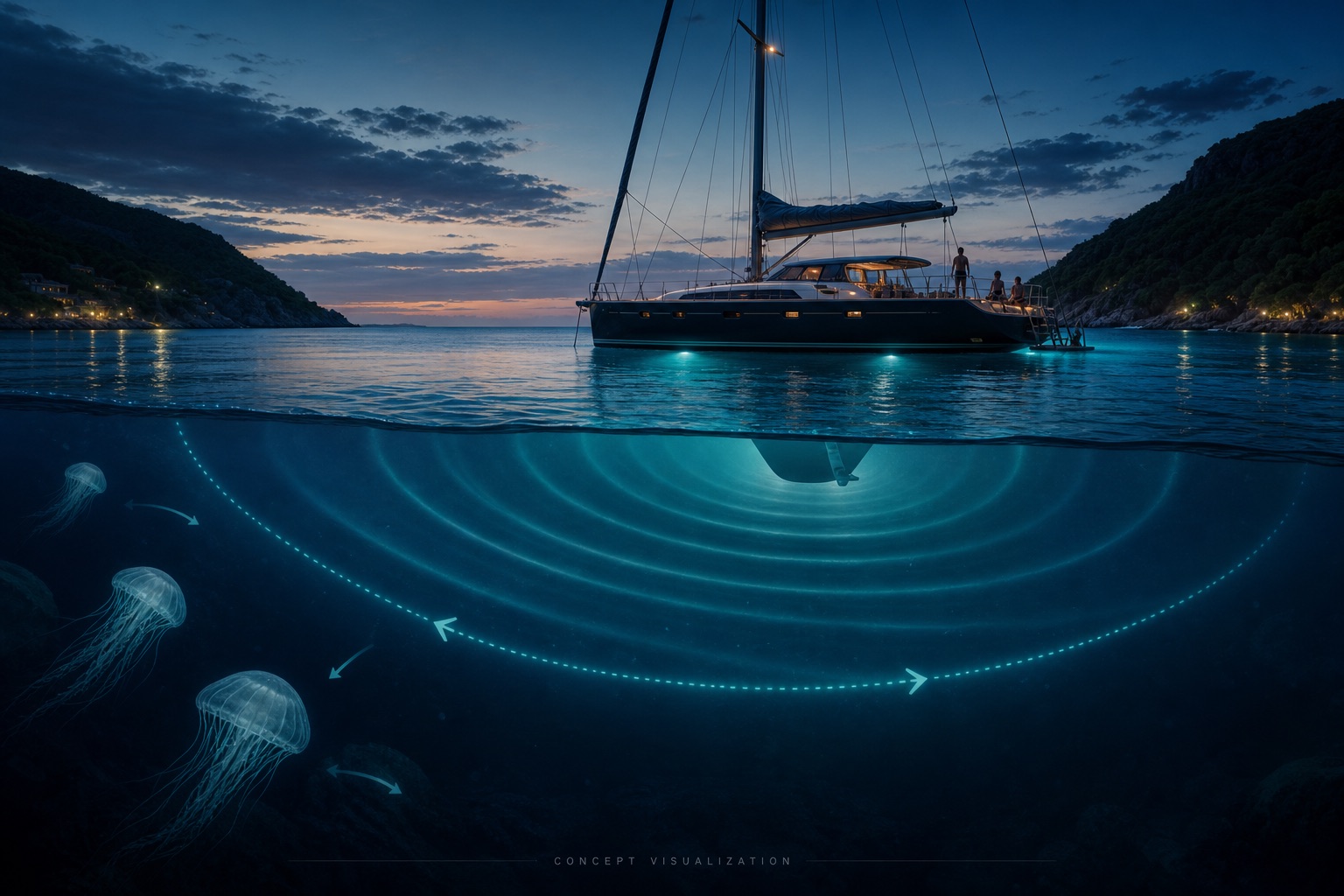
A humane device that gently steers swarms away hits several markets at once:
- A year-round resort season. Removing the "jellyfish season" turns half a year of downtime into revenue. That directly raises the investment appeal and capitalisation of coastal real estate.
- A new safety standard in yachting. For a captain, the ability to reliably let guests into the water in any wild tropical bay is a fundamental advantage, not an option.
- Infrastructure protection. The same barrier shields the water intakes of power plants and desalination plants from swarms that today choke pumps and reactors.
- A global, not local, market. Australia, Southeast Asia, the Mediterranean, Japan — jellyfish blooms are growing worldwide.
This is the horizon the research is heading toward, not a promise for today. First comes a lab proof of a "polite" regime with no harm (see the phases above). But it is exactly the size of the prize that explains why it's worth investing: a successful humane deterrent is a product with almost unlimited commercial potential, born in our low-frequency acoustics lab.
Who runs this
From the founder

"I started HERD on the coast where the 2004 tsunami taught a whole region to listen to the sea. The jellyfish work grew from the same idea: if we understand how ocean animals sense low-frequency motion, we can protect people and infrastructure without harming the animal. This is honest, patent-pending research — we publish what we can prove, and we say plainly what is still a hypothesis."
— Artem Podelenko · partners@theherd.network
Follow the branch
We run the research in the open. Want to see the results of the jellyfish experiments and the rest of the project?
Join us → Library: infrasoundSources
- Solé M., et al. "Evidence of Cnidarians sensitivity to sound after exposure to low frequency underwater sources". Scientific Reports 6, 37979 (2016). pubmed.ncbi.nlm.nih.gov/28000727
- Wang R., et al. "Design and implementation of a jellyfish otolith-inspired MEMS vector hydrophone for low-frequency detection". Microsystems & Nanoengineering 7, 1 (2021). nature.com/articles/s41378-020-00227-w
- Maes J., et al. "Field evaluation of a sound system to reduce estuarine fish intake rates at a power plant cooling water inlet". Journal of Fish Biology (2004). doi:10.1111/j.1095-8649.2004.00360.x
- Sonny D., et al. "Reactions of cyprinids to infrasound… at the cooling water inlet of a nuclear power plant". Journal of Fish Biology (2006); Sand O., et al. (2000) — infrasound and eels. doi:10.1111/j.1095-8649.2006.01146.x
- EPRI. "Cooling Water Intake Debris Management: Jellyfish and Jellyfish-Like Organisms" — a review of methods (bubble curtains, mechanical removal; acoustics for jellyfish — preliminary). EPRI report
- Woith H., et al. "Can Animals Predict Earthquakes?". Bulletin of the Seismological Society of America 108(3) (2018). doi:10.1785/0120170313
This material is educational and describes a research plan; it is not a scientific publication, nor a medical or engineering recommendation. Experiments with living organisms are carried out in compliance with bioethics norms.