嵐の前にクラゲが沖へ移動する — 古くからの観察です。必ずしも天気予報ではありませんが、クラゲには平衡器官があり、嵐は水中を遠くまで伝わる超低周波を生みます。生物学・物理学・実際の取水口事故をつなげると、検証できる話になります。
下は10章、やさしい順。初出の用語はその場で説明し、未確定部分は仮説と明記。末尾に検索付き文献一覧。
視聴: Jellyfish Acoustics
HERDの短編(英語):クラゲが低周波をどう感じるか、bloomsがリゾートと取水口に与える影響、穏やかな音のコリドーとは。下に全文wiki。
英語音声。
クラゲは水をどう感じるか
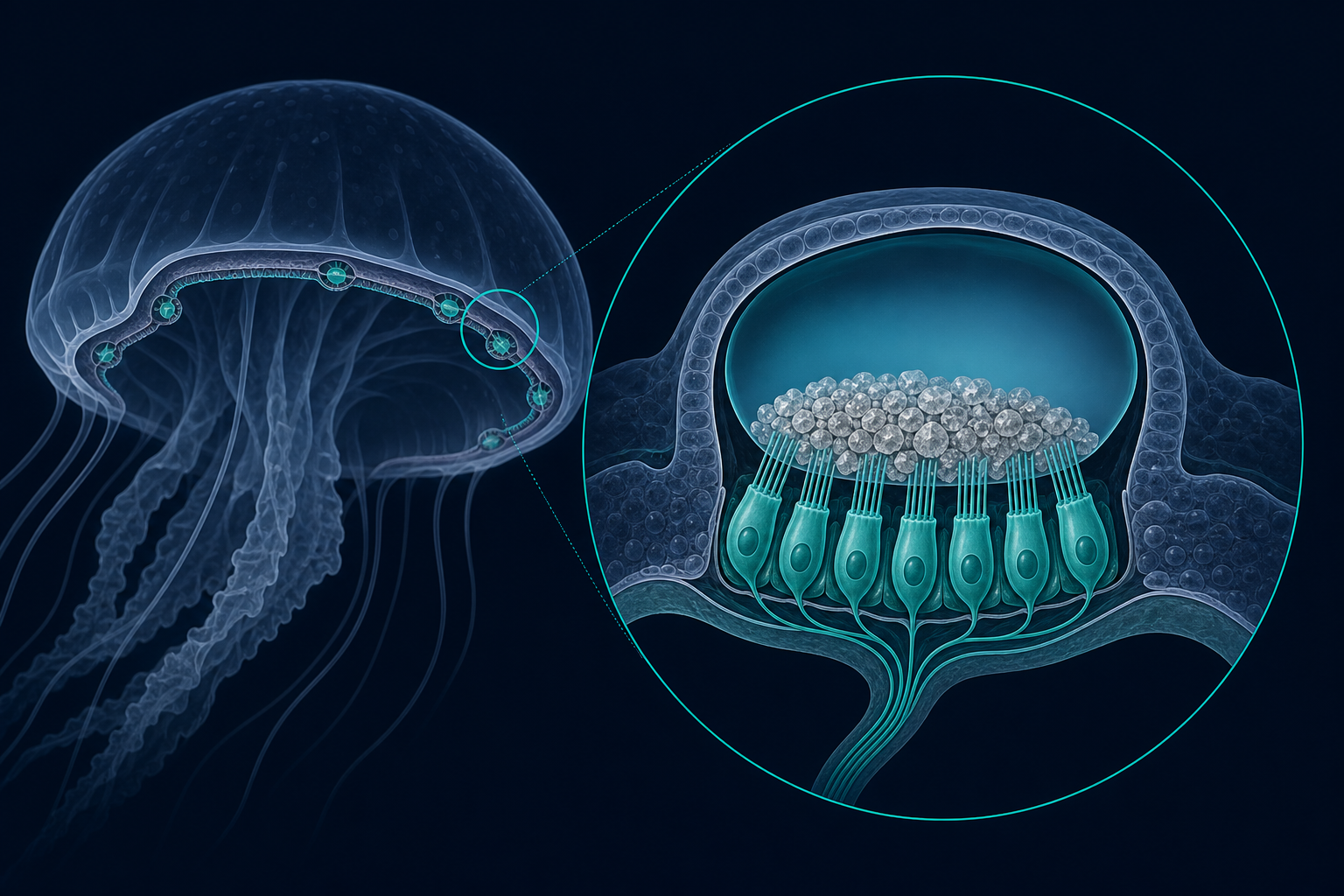
傘の縁には小さな平衡器官 平衡胞(statocyst) があります — 「脳のない耳」とも呼ばれます。内部の粒と感覚毛が、傾き・流れ・水の揺れに反応します。
物理として重要な点:この感覚毛が応じるのは「音の大きさ」(音圧)ではなく、水の粒子そのものの動き(振動加速度)です。魚は圧力を動きに変換する浮き袋を持ちますが、クラゲには浮き袋がありません。したがってクラゲの閾値を通常の「音圧デシベル」で示すのは単位の取り違えです。
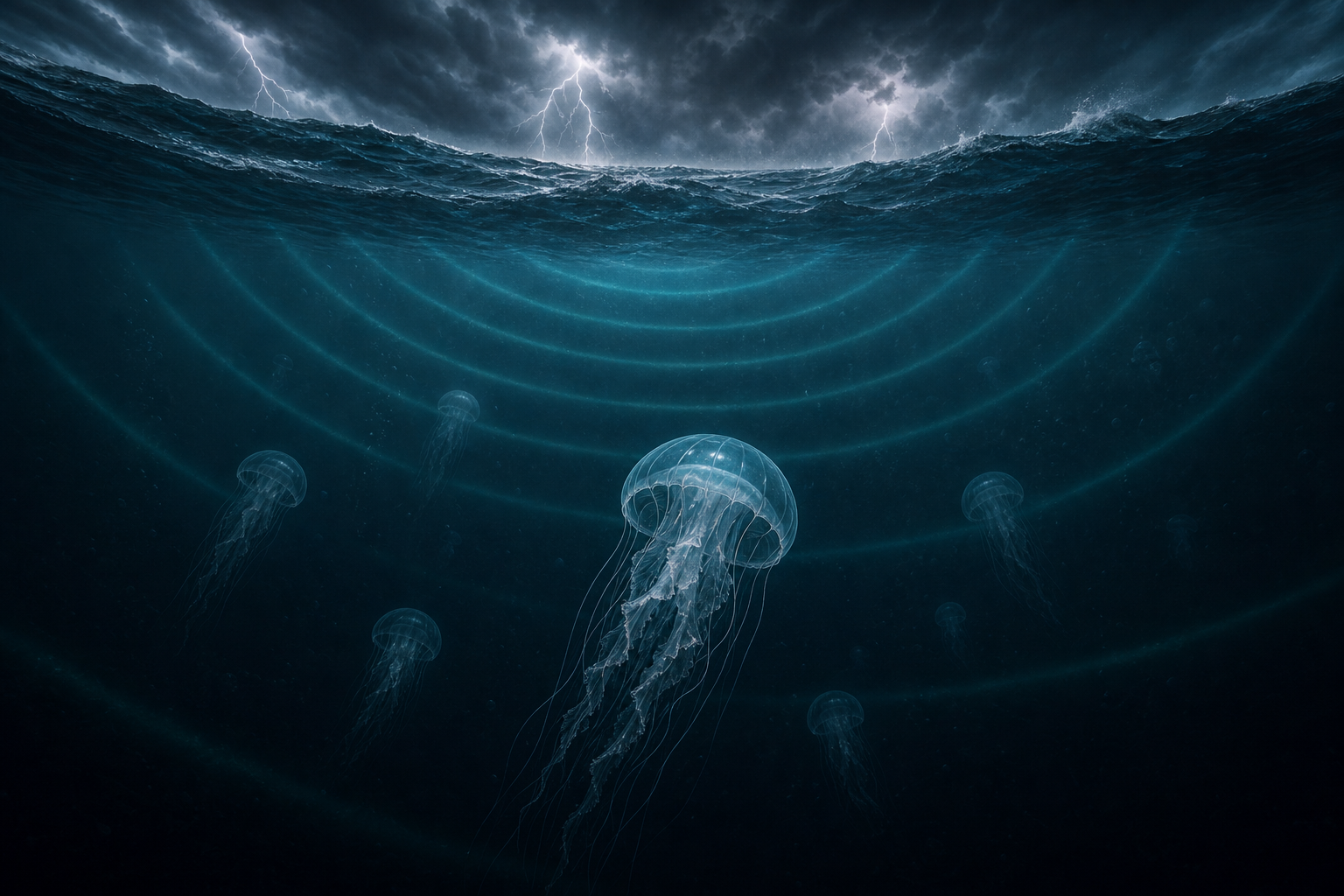
嵐・低い音・沖への移動
嵐の前線は インフラサウンド — 人間の耳には聞こえにくい超低周波 — を生み、空気・水中を数十 km 伝わります。圧や低いうなりとして感じることが多いです。
実験で測定されたこと:50〜400 Hz 帯の大きな音が、まさにこの平衡胞の感覚毛を損傷させました(Solé et al., 2016 — 157 dB re 1 µPa、2時間)。組織が音に無反応ではないことは確かです。一方その研究が測っていないのは行動で、実際に泳いで逃げたかは観察されていません。さらに:クラゲに対する統制されたインフラサウンド(20 Hz 未満)実験は存在しません — 50〜400 Hz はインフラサウンドではありません。「嵐の前に間に合って去る」はなお仮説で、沿岸ごとの検証が必要です。
確かな事実と作業中の仮説を分けます — 読者にも科学にも正直です。
世界の大群
ブルーム — 短期間に数百万個体 — はどこでも同じペースでは増えません。しかし温暖化・栄養塩・乱獲・海岸変化が重なる海域では、繰り返しが目立ちます。
現場で大事なのは「その取水口で毎シーズン起きるか」という単純な問いです。
- クラゲは非常に古い系統で高い適応力を持つ。
- 大群は短時間で冷却取水系に影響する。
- 観光・漁業・淡水化・発電に横断的損失が出る。
リスクの高い沿岸地図
以下は18の再発沿岸(地球規模)。優先度 A:アンダマン、日本、イスラエル、北オーストラリア、メキシコ。B:ブラジル、カリブ、地中海。C:監視・歴史的事例。

| 地域 | 優先度 | 代表種 | 影響 |
|---|---|---|---|
| Andaman: Phuket / Krabi / Phang Nga (TH) | A (高) | Aurelia, cubozoa | 観光、ホテル、淡水化、マリーナ |
| Gulf of Thailand (Samui, Pattaya) | A (高) | Aurelia, Rhizostoma | ビーチ、養殖 |
| East Coast TH (Rayong-Trat) | A (高) | Aurelia | 工業冷却取水 |
| Seto Inland Sea / Osaka Bay (JP) | A (高) | Nemopilema nomurai | 漁業、取水口 |
| Sea of Japan (Fukui, Shimane) | A (高) | Nemopilema, Aurelia | 原発取水口事故 |
| Yellow / East China Sea (CN, KR) | B (中) | Nemopilema, Cyanea | 大規模ブルーム、エネルギーリスク |
| Western Mediterranean (ES, FR, IT) | B (中) | Rhizostoma, Pelagia noctiluca | 観光、漁業 |
| Adriatic coast | B (中) | Rhizostoma | マリーナ、ビーチ |
| Israel Med coast (Ashkelon, Hadera desal) | A (高) | Rhopilema nomadica, Aurelia | 淡水化取水口、水安全保障 |
| North Australia (QLD, NT, WA — stinger coast) | A (高) | Chironex fleckeri, Irukandji | ハブクラゲ、ヨット、stinger season |
| US Gulf / East Coast | C (監視) | Sea nettle, Mnemiopsis | 漁業、発電所運転 |
| Black Sea / Sea of Azov | C (監視) | Mnemiopsis leidyi | 歴史的生態系崩壊 |
| Irish Sea / UK west | C (監視) | Various species | 観光とパイロット監視 |
| Malta / Eastern Med islands | C (監視) | Rhizostoma | 淡水化+観光 |
| West Africa (Benguela) | C (監視) | Large scyphozoans | 漁業への圧力 |
| Mexico Gulf & Yucatán (Veracruz, Cancún, Campeche) | A (高) | Aurelia, Tamoya, Stomolophus | 観光、PEMEX冷却、クルーズ |
| Brazil SE coast (Santos, Rio, São Paulo state) | B (中) | Lychnorhiza, Olindias, Aurelia | ビーチ、Angra原発、漁業 |
| Caribbean (Cuba, Jamaica, Puerto Rico, Dominican Rep.) | B (中) | Aurelia, Cassiopea, cubozoa | 観光、クルーズ港、島嶼淡水化 |
地中海岸は世界で最も淡水化に依存する地域の一つ。Rhopilema nomadica と Aurelia の夏の群れが Ashkelon、Hadera などの取水口を繰り返し詰まらせ、2019年には数時間供水が止まった。水不足の国にとってビーチの問題ではなく水・エネルギー安全保障。utility 向け HERD パイロット Tier A。
クイーンズランド、北部準州、WA は Chironex fleckeri と小さいが致命的な イルカンジ の生息域。stinger season は半年水泳禁止、ネットとスティンガースーツが標準。数千 km の海岸 — プレミアムヨット、リゾート、野生の湾でのゲスト安全。人道的 LF バリアは医療・商用両面 — クラゲ R&D.
ベラクルス、カンクン、カンペチェ — Aurelia、Tamoya、Stomolophus:ビーチ、PEMEX 冷却、クルーズ。HERD LATAM パイロット(Popocatépetl 周辺)と bloom が観光・インフラを襲う沿岸。
夏の Lychnorhiza と Olindias の bloom がサンパウロとリオのビーチを閉鎖。Angra 原発と busy な港。監視+穏やかな音響 — リゾートと utility 向けパイロット。
キューバ、ジャマイカ、プエルトリコ、ドミニカ — 混雑ビーチの Aurelia、Cassiopea、cubomedusa。クルーズ港と島嶼淡水化で bloom はインフラリスク。
発電所と取水口
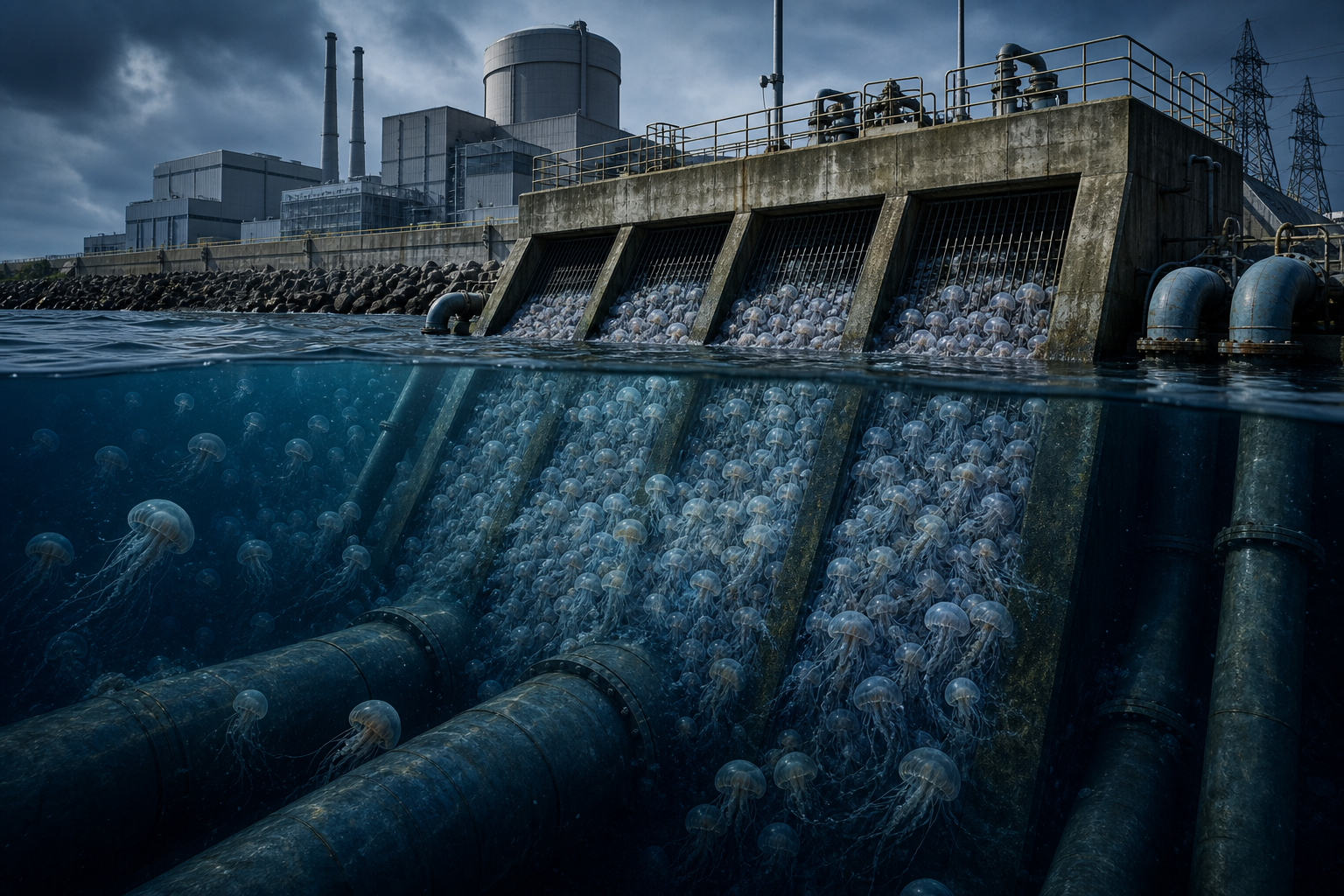
沿岸の原発・火力・淡水化設備は、スクリーンとフィルタで大量の海水を汲み上げます。密集したクラゲ群は数時間で詰まらせ、出力低下や停止リスクを高めます。
日本・英国・スウェーデン・イスラエル・北オーストラリアで実例 — 原発取水口から刺傷シーズンのビーチ閉鎖まで。
| 年 | 施設 | 国 | 影響 |
|---|---|---|---|
| 2011 | Shimane Nuclear PP | Japan | 冷却水制限 |
| 2011 | Torness Nuclear PP | UK | 一時停止 |
| 2013 | Oskarshamn Nuclear PP | Sweden | 主要炉停止 |
| 2019 | Desalination plant | Israel | 取水口詰まり |
| 2021 | Torness | UK | 再発イベント |
| 2023 | Northern beaches (QLD/NT) | Australia | ビーチ閉鎖、stinger season |
| 2024-2025 | Multiple coastal plants | China | 地域ブルーム圧力 |
| 2025 | Gravelines Nuclear PP | France | 4基が停止 |
主要種
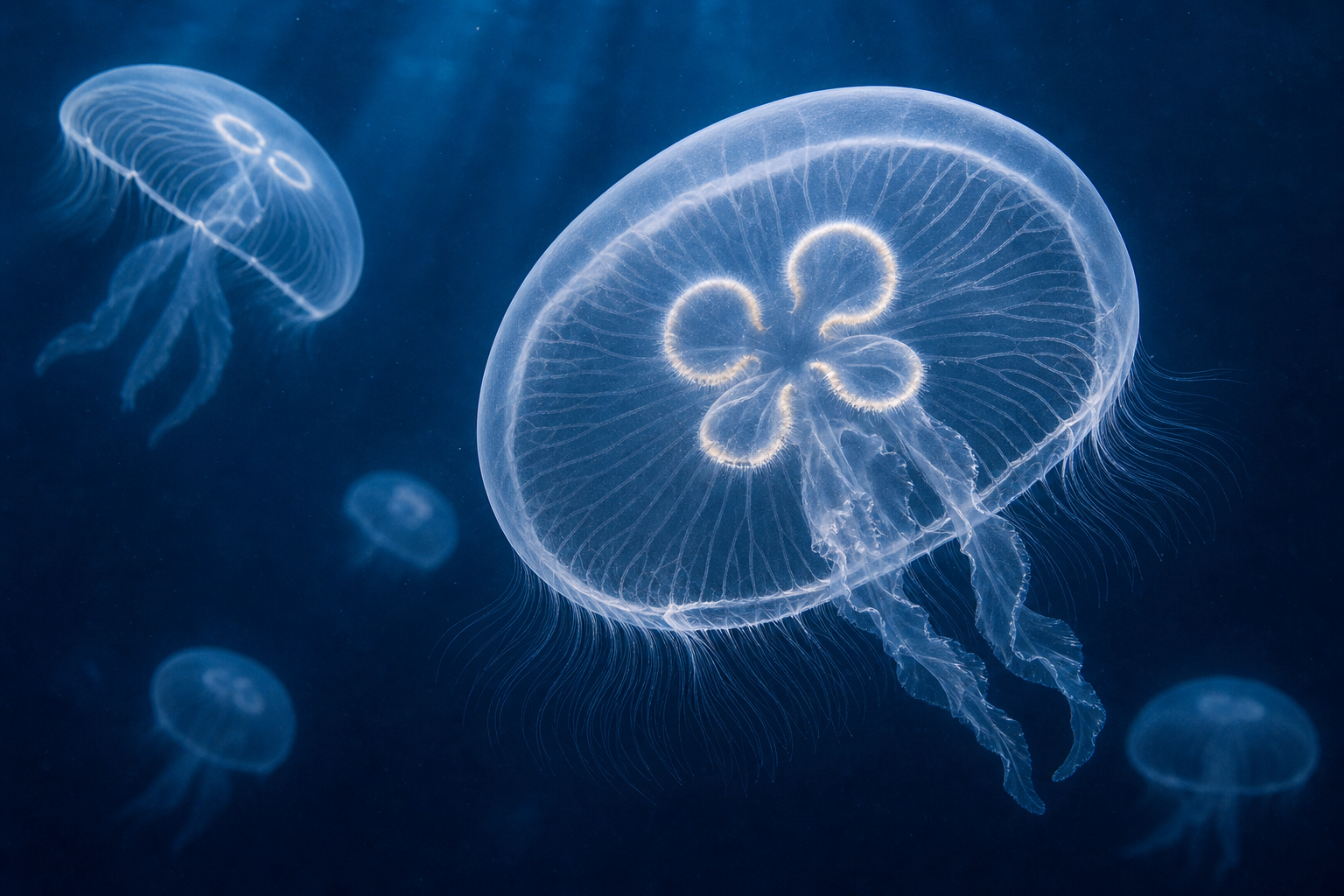
大規模群 — ビーチと取水口で評判・インフラ被害。
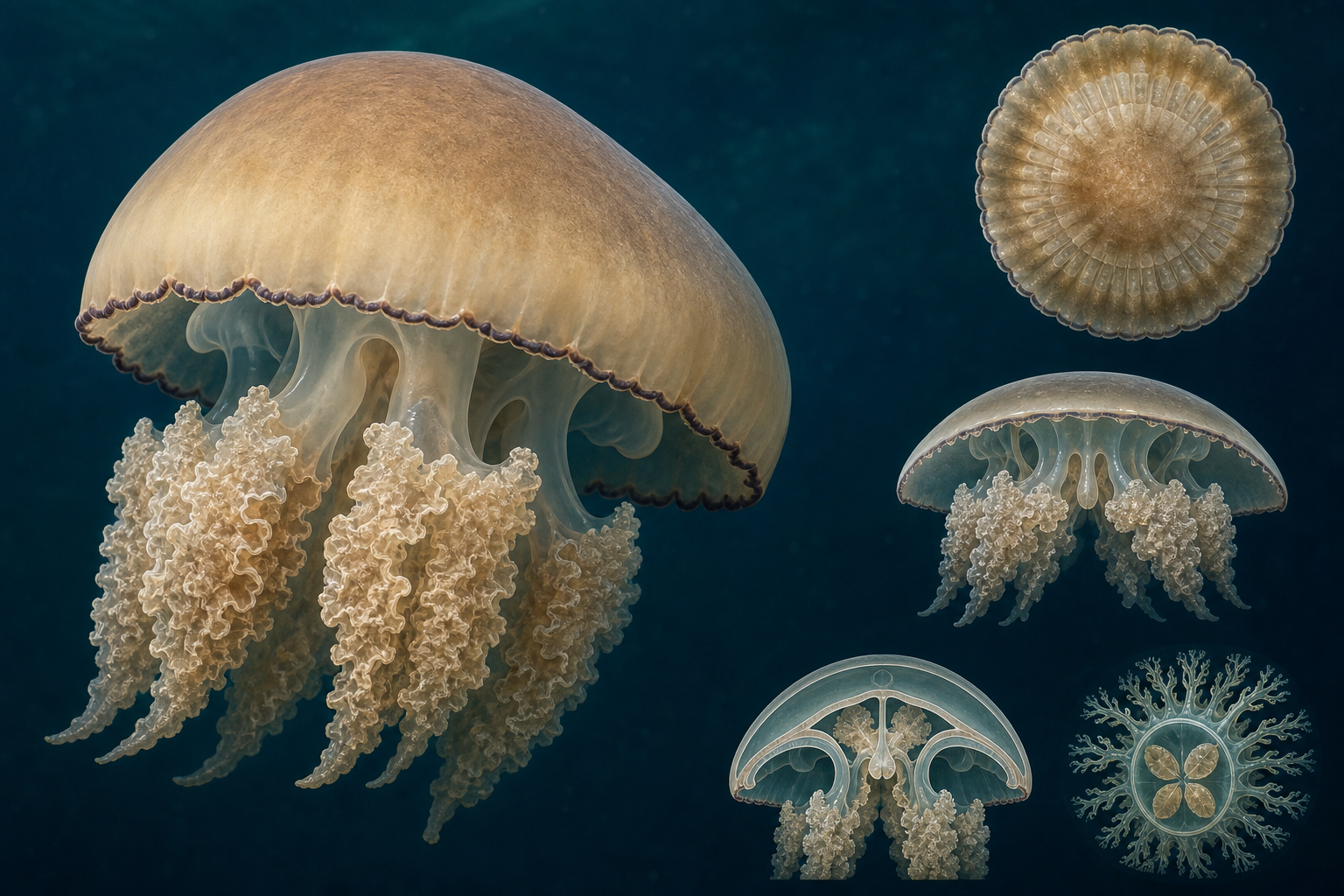
地中海の典型種 — リゾート近くの大型クラゲ。
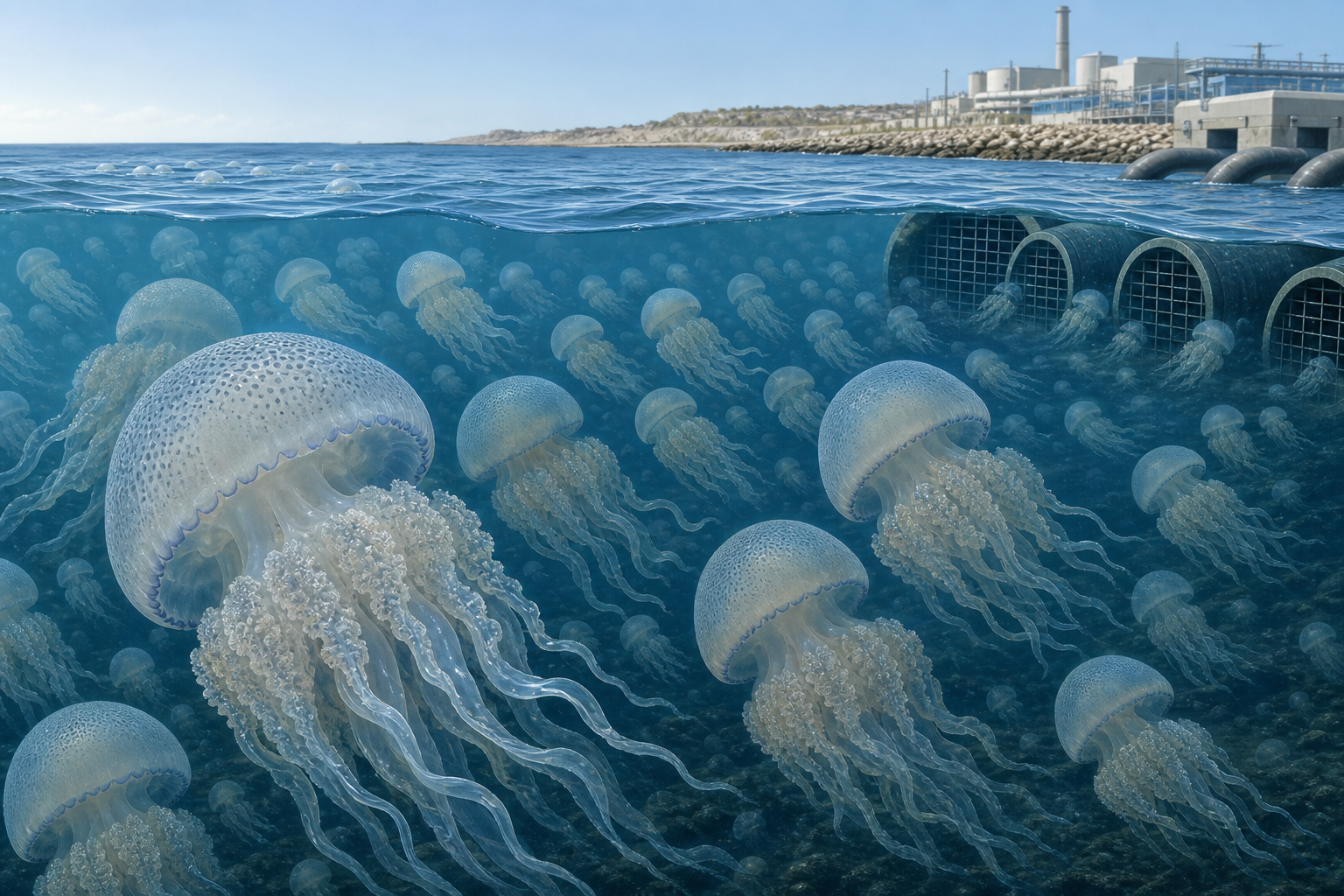
イスラエル・レバント沿岸の侵入種 — 夏の群れが淡水化 intake を詰まらせる。
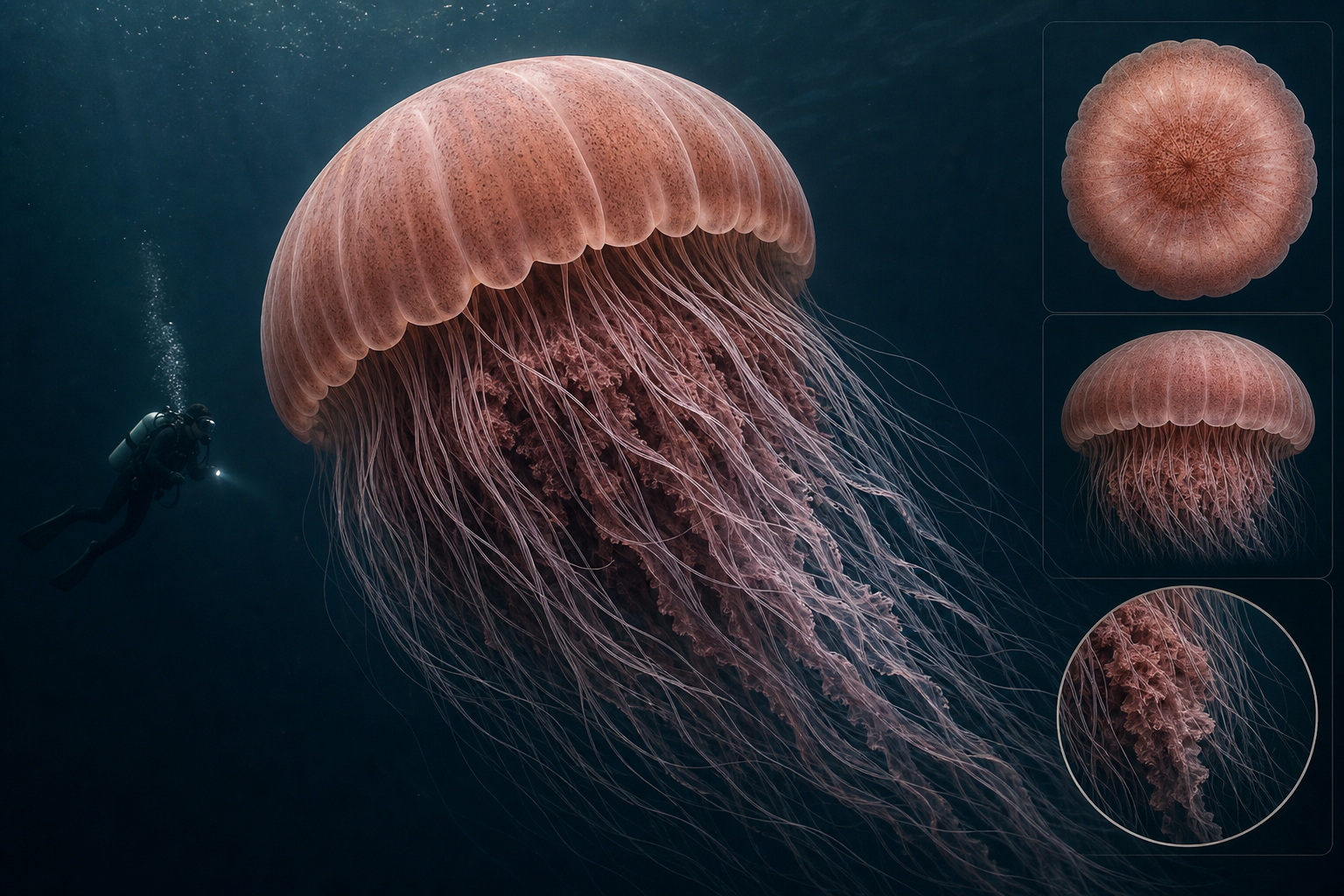
東アジアの巨大ブルーム — 漁業と取水口リスク。
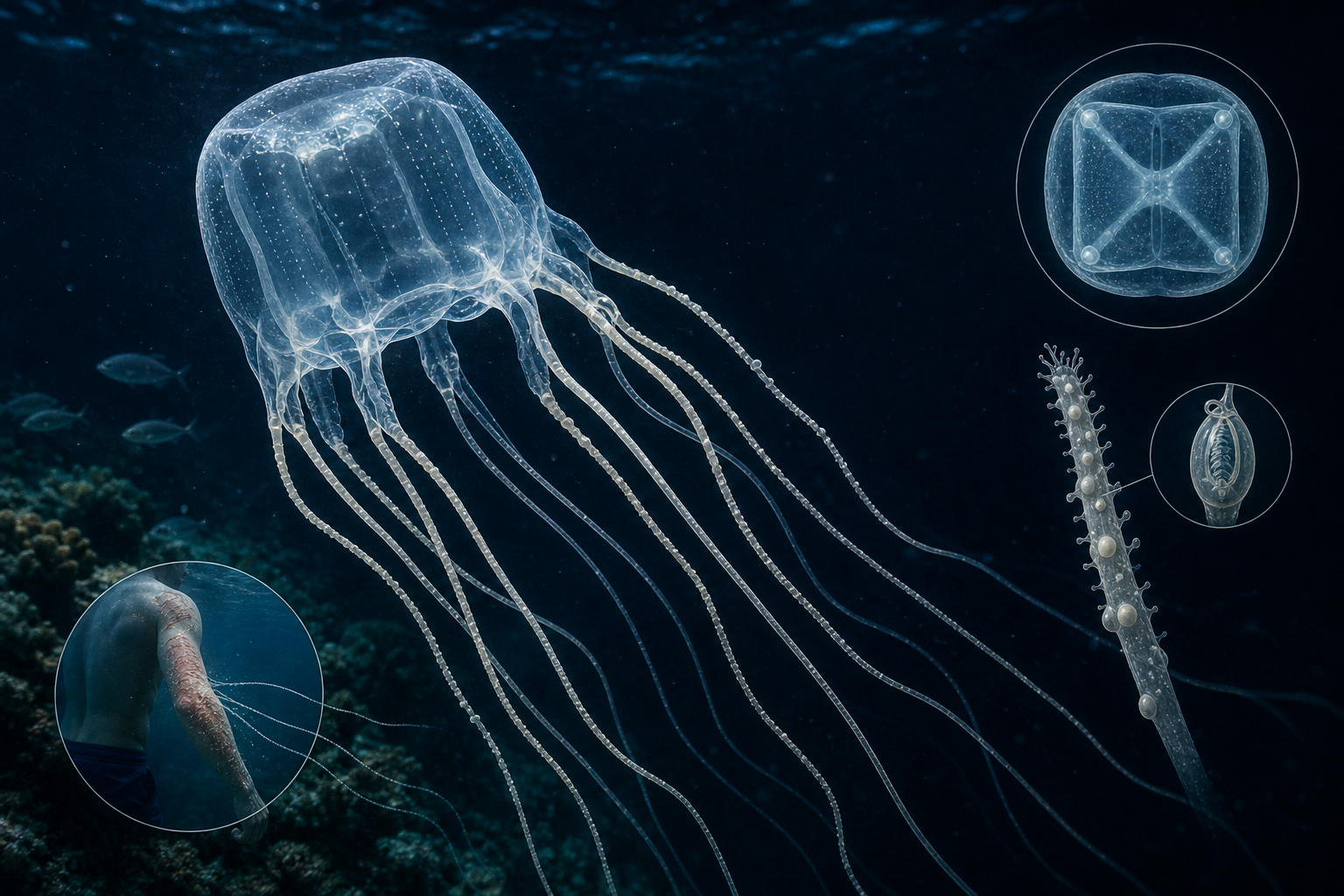
高い医学的リスク — 北オーストラリア、stinger season、ヨット。
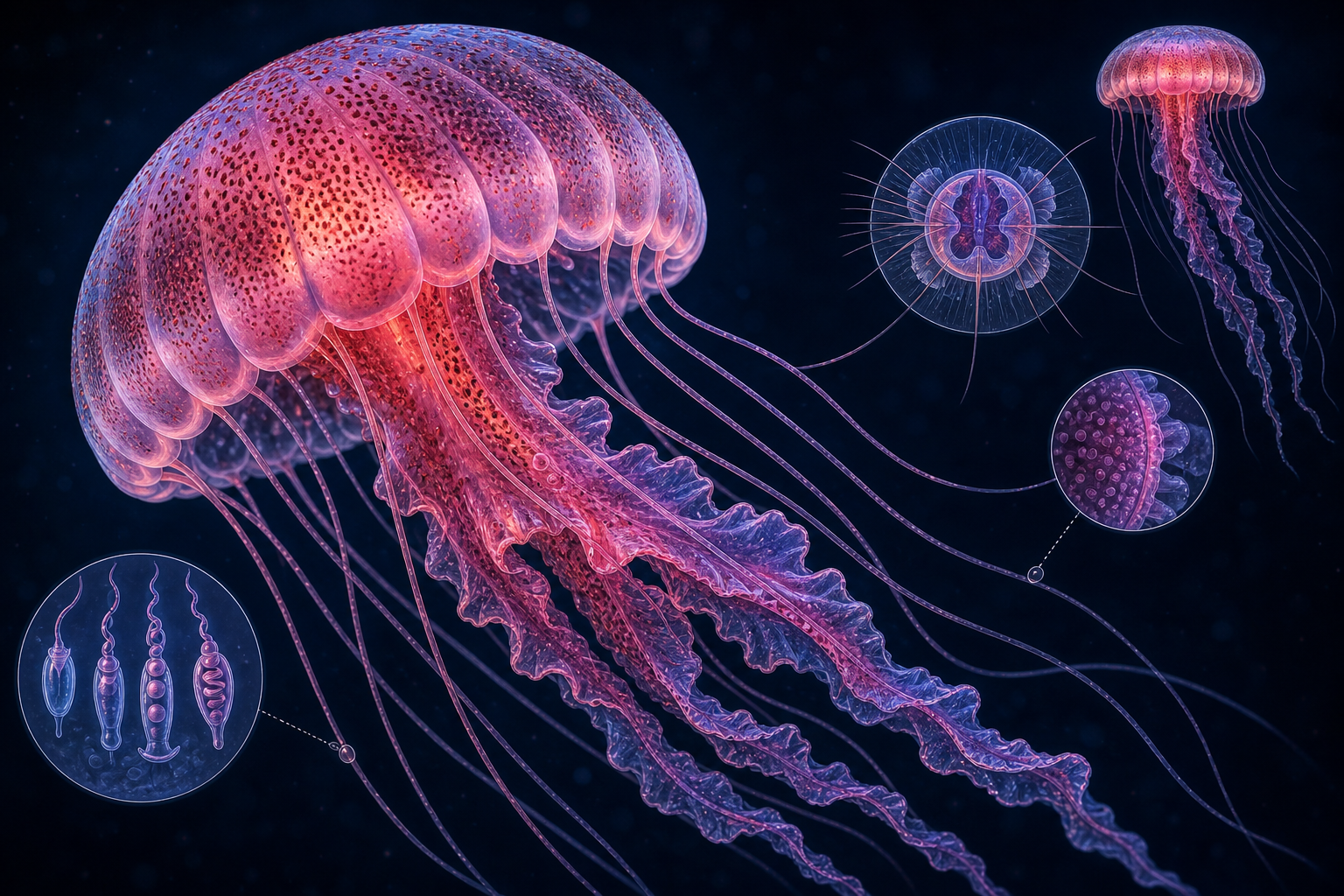
地中海観光地で頻繁な刺胞 — ツノマンボウ。
音:測られたこと、まだ測られていないこと
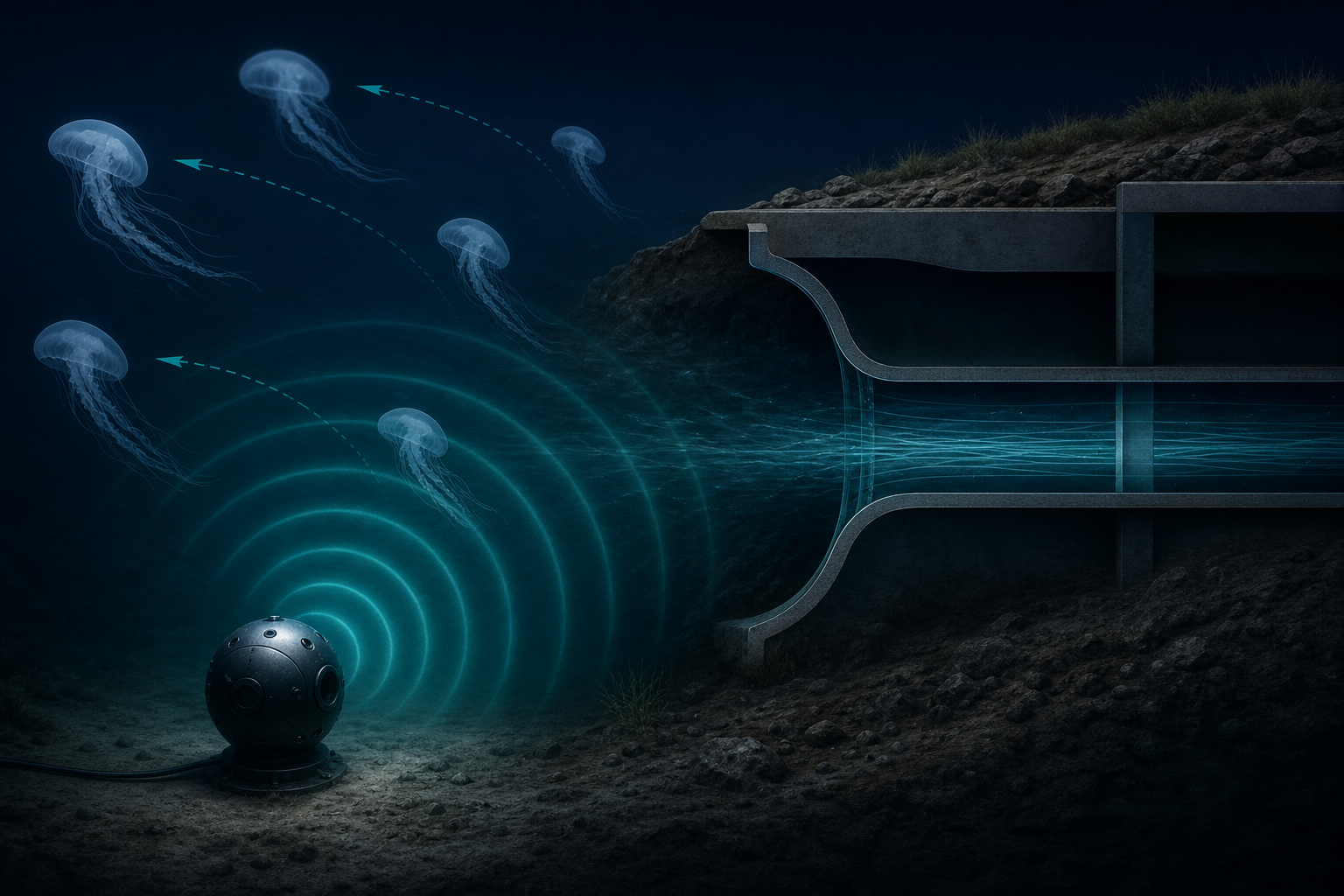
測られたこと:大きな 50〜400 Hz の音は平衡胞を損傷させる(Solé et al., 2016)。測られていないこと:既知の用量で音からクラゲが離れて行くかどうか — 統制された回避研究は存在しません。その種の観察は一件だけで定性的です:ヒドロクラゲが振動する針から向きを変え下方へ泳ぎ去った(Horridge, 1966) — 反応の向きはあるが、閾値も用量もありません。魚の取水口では調整済みの音響抑止が実際に機能しますが、そのパラメータは移せません。魚には浮き袋と音圧聴覚があり、クラゲにはどちらもありません。
クラゲの未解決点:平衡器官を傷つけずに群れをやんわり誘導できるか — HERDの中心仮説です。
今の対策
| 手法 | 利点 | 課題 |
|---|---|---|
| 物理ネット | 海岸保護に直感的 | 高コスト・維持負担 |
| バブルカーテン | 水理的遮断が可能 | 電力消費・設置制約 |
| 機械除去 | 即効性 | 非人道的で環境負荷 |
| 魚向けAFD | 魚で実績 | クラゲ最適化不足 |
| HERD LFバリア | 人道的スケール可能性 | 研究段階 |
HERDネットワーク
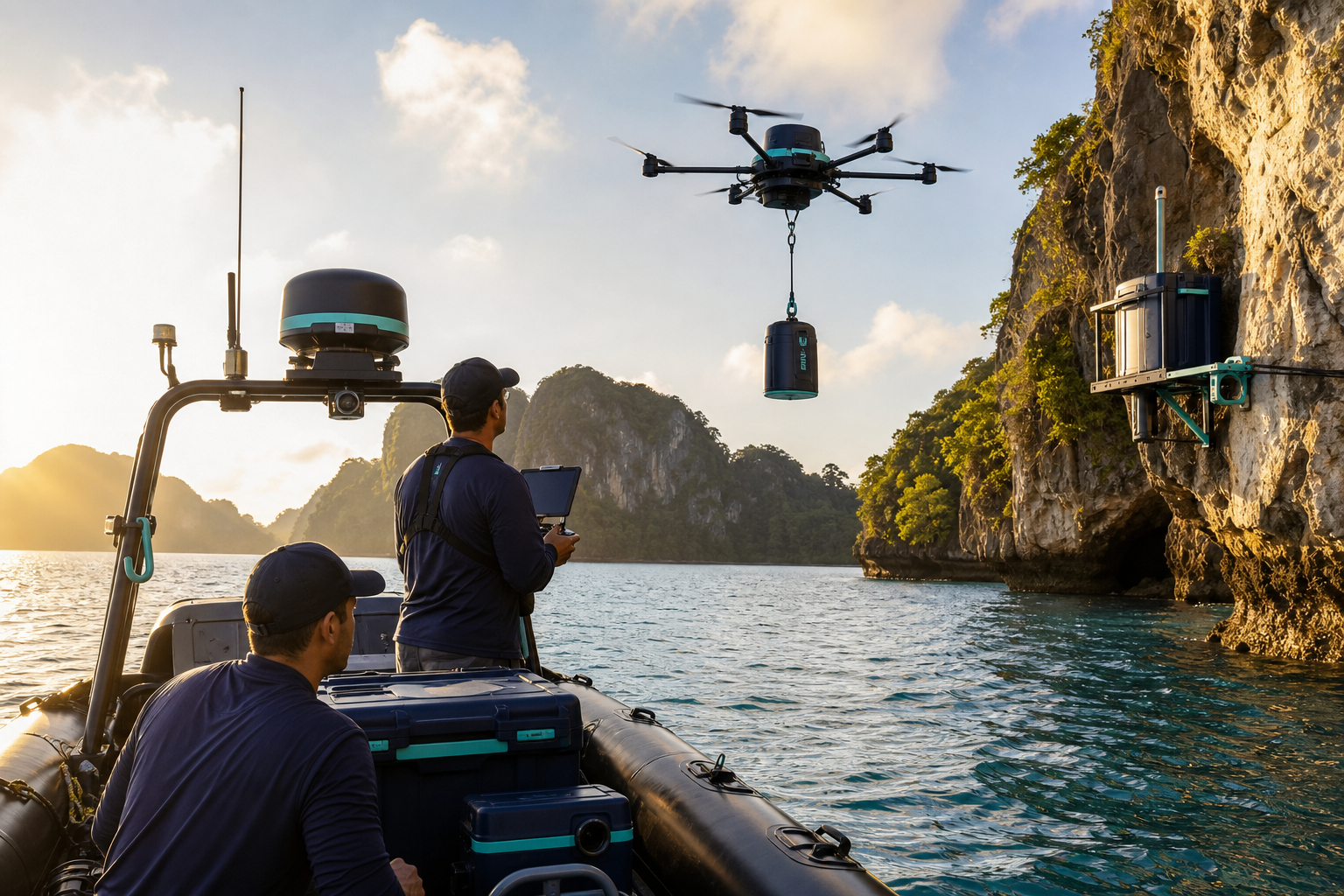
HERDは二段階:低コストセンサーで前兆を捉え、やさしい音の「コリドー」で取水口から離す試験。
ビーチ閉鎖や停止の前に、リゾート・港湾・ユーティリティが判断できる体制が目的です。
241文献
各文献を平易な言葉で要約。タイトル・著者・テーマ・タグで検索。
該当なし — 別のキーワードをお試しください。
文献 1-75
- 査読あり Sole M. et al. (2016). Evidence of Cnidarians sensitivity to sound after exposure to low frequency noise. Scientific Reports. リンク
刺胞動物(クラゲ・サンゴ)が低周波音を感知・反応する実験的根拠。
- 査読あり Wang R. et al. (2021). Jellyfish otolith-inspired MEMS vector hydrophone for low-frequency detection. Microsystems and Nanoengineering. リンク
クラゲ stato シストを模倣した低周波水中検知用 MEMS ベクトル水听器。
- レビュー Purcell J.E., Uye S., Lo W.T. (2007). Anthropogenic causes of jellyfish blooms and their direct consequences for humans. Marine Ecology Progress Series. リンク
人為的活動とクラゲ大量発生・社会への影響を結ぶレビュー。
- 査読あり Maes J. et al. (2004). Field evaluation of a sound system to reduce estuarine fish intake rates at a power plant cooling water inlet. Journal of Fish Biology. リンク
発電所冷却水取水口をクラゲが詰まらせる問題 — 実証・事例・管理指針。
- 査読あり Sonny D. et al. (2006). Reactions of cyprinids to infrasound at a nuclear power plant cooling-water inlet. Journal of Fish Biology. リンク
発電所冷却水取水口をクラゲが詰まらせる問題 — 実証・事例・管理指針。
- 査読あり Woith H., Petersen G.M., Hainzl S., Dahm T. (2018). Can Animals Predict Earthquakes? Bulletin of the Seismological Society of America. リンク
動物が地震を予知できるという主張の批判的検討。
- 機関 EPRI (2017). Cooling Water Intake Debris Management: Jellyfish and Jellyfish-Like Organisms. Electric Power Research Institute. リンク
発電所冷却水取水口をクラゲが詰まらせる問題 — 実証・事例・管理指針。
- 歴史 Spangenberg D.B. (1986). Statocyst structure and function in Cnidaria. Fortschritte der Zoologie.
ゼラチン性浮遊生物などの平衡器官( stato シスト)の構造と機能。
- レビュー Tiemann H. et al. (2009). Gelatinous zooplankton statocyst and sensory biology overview. Marine Ecology.
ゼラチン性浮遊生物などの平衡器官( stato シスト)の構造と機能。
- 査読あり Mooney T.A. et al. (2010). Ontogeny of hearing in the squid Loligo pealeii. Biological Bulletin. リンク
上記引用テーマに関する査読付き研究論文。 テーマ:「Ontogeny of hearing in the squid Loligo pealeii»。
- 査読あり Budelmann B.U. (1979). Hair cell responses in the octopus statocyst. Journal of Comparative Physiology.
ゼラチン性浮遊生物などの平衡器官( stato シスト)の構造と機能。
- レビュー Bedard A.J., Georges T.M. (2000). Atmospheric Infrasound. Physics Today. リンク
大気 infrasound の源・伝播・観測の概説。
- 査読あり Elbing B.R., Petrin C.E., Van Den Broeke M.S. (2019). Measurement and characterization of infrasound from a tornado-producing storm. Journal of the Acoustical Society of America. リンク
猛烈な嵐・竜巻・雷雨渦から発生する infrasound。
- 査読あり Waxler R., Gilbert K.E. (2006). The radiation of atmospheric microbaroms by ocean waves. Journal of the Acoustical Society of America. リンク
マイクロバロム — 海面波と大気の結合による連続 infrasound。
- 査読あり Condon R.H. et al. (2013). Recurrent jellyfish blooms are a consequence of global oscillations. Proceedings of the National Academy of Sciences. リンク
クラゲ大量発生の大域要因(気候振動・漁業・富栄養化)。
- レビュー Richardson A.J. et al. (2009). The jellyfish joyride: causes, consequences and management responses to a more gelatinous future. Trends in Ecology and Evolution. リンク
海洋生態系でのクラゲ優位化と管理オプションの政策向けレビュー。
- 査読あり Sanz-Martin M. et al. (2018). Claims that anthropogenic stressors facilitate jellyfish blooms have been amplified beyond the available evidence. Frontiers in Marine Science. リンク
人為的活動とクラゲ大量発生・社会への影響を結ぶレビュー。
- メディア Gershwin L. (2013). Stung! On Jellyfish Blooms and the Future of the Ocean. University of Chicago Press.
クラゲで原子力・海水淡水化・沿岸インフラが停止した報道・書籍。
- メディア Sixth Tone (2024). Gridlocked: When Jellyfish Brought a China Power Plant to Its Knees. Sixth Tone. リンク
クラゲで原子力・海水淡水化・沿岸インフラが停止した報道・書籍。
- レビュー Graham W.M. et al. (2014). Linking human well-being and jellyfish ecosystem services and disservices. Current Opinion in Environmental Sustainability. リンク
クラゲの生態系サービス(炭素循環・食物網)と迷惑の両面。
- 機関 European Commission (2011). EcoJel project: jellyfish occurrence and management in the Irish Sea. European Union Regional Policy. リンク
クラゲの生物学・大量発生・影響・沿岸・外洋での管理。
- レビュー Uye S. (2008). Blooms of the giant jellyfish Nemopilema nomurai in the East Asian marginal seas: review and synthesis. Plankton and Benthos Research. リンク
東アジアの越前クラゲ(Nomura)の生態と漁業への影響。
- メディア NHK News (2011). Jellyfish affected cooling-water intake operation at Shimane nuclear station. NHK archives.
発電所冷却水取水口をクラゲが詰まらせる問題 — 実証・事例・管理指針。
- 査読あり Dong J. et al. (2010). Bloom dynamics of jellyfish in the Yellow Sea and East China Sea. Progress in Natural Science.
世界のクラゲ個体数・大量発生のトレンド・原因・生態系影響。
- レビュー Boero F. et al. (2016). Jellyfish surge in the Mediterranean Sea: threat or opportunity? Mediterranean Marine Science. リンク
地中海・黒海・NOAA 水域向けクラゲモニタリング運用指針。
- メディア The Times of Israel (2019). Jellyfish clog desalination plant intake systems during summer blooms. The Times of Israel. リンク
発電所冷却水取水口をクラゲが詰まらせる問題 — 実証・事例・管理指針。
- 査読あり Fenner P.J., Williamson J.A., Burnett J.W. (2010). Irukandji and Chironex box jellyfish envenomation. Wilderness and Environmental Medicine. リンク
オーストラリア・熱帯の危険なハブクラゲ類(Chironex・イrukandji)の医学と生態。
- 査読あり Brodeur R.D. et al. (2002). Rise and fall of jellyfish in the eastern Bering Sea in relation to climate regime shifts. Progress in Oceanography. リンク
気候変動・海洋温暖化がクラゲ大量発生に与える影響。
- 査読あり Kideys A.E. (2002). Fall and rise of the Black Sea ecosystem and the anchovy fishery: effects of gelatinous zooplankton on marine food webs. Marine Ecology Progress Series. リンク
ゲル状浮遊生物が黒海の食物網とアンチョビ漁業をどう変えたか。
- レビュー Pitt K.A., Lucas C.H. (2014). Jellyfish Blooms. Springer. リンク
世界のクラゲ個体数・大量発生のトレンド・原因・生態系影響。
- 査読あり Brotz L. et al. (2012). Increasing jellyfish populations: trends in large marine ecosystems. Hydrobiologia. リンク
世界のクラゲ個体数・大量発生のトレンド・原因・生態系影響。
- 査読あり Brotz L. et al. (2012). Global analysis of jellyfish fisheries and blooms. Marine Biology. リンク
世界のクラゲ個体数・大量発生のトレンド・原因・生態系影響。
- メディア BBC News (2011). Torness nuclear power station shut after jellyfish swarm. BBC. リンク
クラゲで原子力・海水淡水化・沿岸インフラが停止した報道・書籍。
- メディア The Guardian (2013). Swedish reactor at Oskarshamn shut by jellyfish. The Guardian. リンク
クラゲで原子力・海水淡水化・沿岸インフラが停止した報道・書籍。
- メディア Energy Voice (2020). Drones and imaging tested for jellyfish early warning at cooling intakes. Energy Voice. リンク
クラゲの生物学・大量発生・影響・沿岸・外洋での管理。
- 査読あり Burnett J.W., Gable W.D. (1989). A fatal jellyfish envenomation by Chironex fleckeri. Toxicon. リンク
オーストラリア・熱帯の危険なハブクラゲ類(Chironex・イrukandji)の医学と生態。
- レビュー Popper A.N., Hawkins A.D. (2019). An overview of fish bioacoustics and the impacts of anthropogenic sounds. Journal of Fish Biology. リンク
魚類の聴覚と人為的水下ノイズの影響の概説。
- 機関 State Intellectual Property Office of China (2017). CN106973350A: Infrasound jellyfish repelling device. CN Patent. リンク
産業取水口付近での魚類の infrasound 反応 — 音響魚類忌避の基礎。
- レビュー Nestler J.M. et al. (1992). Behavior barriers and fish guidance systems at water intakes. American Fisheries Society Symposium.
発電所冷却水取水口をクラゲが詰まらせる問題 — 実証・事例・管理指針。
- 査読あり Lo W.T. et al. (2008). Population outbreaks of jellyfish and links to environmental change around Taiwan. Fisheries Science.
世界のクラゲ個体数・大量発生のトレンド・原因・生態系影響。
- 査読あり Arai M.N. (2009). The potential importance of podocysts to the formation of scyphozoan blooms: a review. Hydrobiologia. リンク
上記引用テーマに関する査読付き研究論文。 テーマ:「The potential importance of podocysts to the formation of scyphozoan blooms: a review»。
- レビュー Purcell J.E. (2012). Jellyfish and ctenophore blooms coincide with human proliferations and environmental perturbations. Annual Review of Marine Science. リンク
世界のクラゲ個体数・大量発生のトレンド・原因・生態系影響。
- レビュー Lucas C.H., Gelcich S., Uye S., Brotz L. (2014). Gelatinous zooplankton and ecosystem services. Advances in Marine Biology. リンク
引用テーマの知見をまとめたレビュー論文。 テーマ:「Gelatinous zooplankton and ecosystem services»。
- 査読あり Canepa A., Fuentes V., Sabates A., Piraino S., Boero F. (2014). Pelagia noctiluca in Mediterranean coastal systems and implications for tourism and fisheries. Marine Biology.
地中海の Pelagia noctiluca 大量発生 — 観光・漁業・生態系への影響。
- レビュー Hays G.C., Doyle T.K., Houghton J.D.R. (2018). A paradigm shift in jellyfish research priorities. Frontiers in Marine Science. リンク
クラゲの生物学・大量発生・影響・沿岸・外洋での管理。
- 機関 FAO (2018). Jellyfish fisheries and aquaculture in Asia: status and prospects. Food and Agriculture Organization. リンク
クラゲと漁業の相互作用 — 捕食・混獲・経済損失。
- 査読あり Kawahara M., Uye S., Ohtsu K., Iizumi H. (2006). Unusual population explosion of the giant jellyfish Nemopilema nomurai in East Asian waters. Plankton and Benthos Research. リンク
東アジアの越前クラゲ(Nomura)の生態と漁業への影響。
- 査読あり Sand O., Enger P.S., Karlsen H.E. (2000). Detection of infrasound and linear acceleration in fish and behavioral avoidance responses. Journal of Experimental Biology. リンク
産業取水口付近での魚類の infrasound 反応 — 音響魚類忌避の基礎。
- 機関 GFCM and FAO (2013). Review of jellyfish blooms in the Mediterranean and Black Sea. GFCM Studies and Reviews. リンク
ゲル状浮遊生物が黒海の食物網とアンチョビ漁業をどう変えたか。
- レビュー Graham W.M., Martin D.L., Felder D.L., Asper V.L., Perry H.M. (2003). Ecological and economic implications of gelatinous zooplankton blooms. Marine Ecology Progress Series. リンク
引用テーマの知見をまとめたレビュー論文。 テーマ:「Ecological and economic implications of gelatinous zooplankton blooms»。
- 査読あり Bedard A.J. (2005). Low-frequency atmospheric acoustic energy associated with vortices produced by thunderstorms. Monthly Weather Review. リンク
猛烈な嵐・竜巻・雷雨渦から発生する infrasound。
- 査読あり Marchetti E., Ripepe M., Ulivieri G., Kogelnig A. (2015). Infrasound array criteria for automatic detection and front velocity estimation of snow avalanches. Natural Hazards and Earth System Sciences. リンク
山岳地帯の雪崩自動検知・前端速度推定の infrasound アレイ。
- 査読あり Mayer S., van Herwijnen A., Ulivieri G., Schweizer J. (2020). Evaluating the performance of an operational infrasound avalanche detection system. Cold Regions Science and Technology. リンク
山岳地帯の雪崩自動検知・前端速度推定の infrasound アレイ。
- 機関 Wyssen Avalanche Control AG (2024). IDA Infrasound Detection System for avalanches. Wyssen technical documentation. リンク
山岳地帯の雪崩自動検知・前端速度推定の infrasound アレイ。
- レビュー van Kamp I., van den Berg F. (2018). Health effects related to wind turbine sound, including low-frequency sound and infrasound. Acoustics Australia. リンク
風力タービン低周波・ infrasound と健康訴えの科学的レビュー。
- レビュー McCunney R.J., Mundt K.A., Colby W.D., Dobie R., Kaliski K., Blais M. (2014). Wind turbines and health: a critical review of the scientific literature. Journal of Occupational and Environmental Medicine. リンク
風力タービン低周波・ infrasound と健康訴えの科学的レビュー。
- 機関 JASON Advisory Group (2018). An analysis of hypotheses related to embassy health incidents. U.S. Department of State report. リンク
ハバナ症候群等の大使館 sonic 事案と代替説明の調査。
- 査読あり Stubbs A.L., Montealegre-Z F. (2019). Recording of sonic attacks on U.S. diplomats in Cuba spectrally matches the calling song of a Caribbean cricket. bioRxiv. リンク
ハバナ症候群等の大使館 sonic 事案と代替説明の調査。
- 機関 Raspberry Shake S.A. (2026). Raspberry Shake and Boom citizen seismo-acoustic network. Raspberry Shake. リンク
低コスト地中・大気モニタリングの Raspberry Shake/Boom 市民ネットワーク。
- 機関 Bosch Sensortec (2026). BMP388 high-accuracy barometric pressure sensor. Product documentation. リンク
infrasound・マイクロバロム研究向け高精度 BMP388 系 MEMS 気圧センサ。
- 機関 ARISE Consortium (2026). Atmospheric dynamics Research InfraStructure in Europe. ARISE project. リンク
大気力学向け infrasound・ライダー・レーダーを統合する欧州 ARISE インフラ。
- レビュー Fee D., Matoza R.S. (2013). An overview of volcano infrasound: from Hawaiian to Plinian, local to global. Journal of Volcanology and Geothermal Research. リンク
火山噴火の検知・定位・早期警戒への infrasound 利用。
- レビュー Watson L.M., Matoza R.S., Fee D., et al. (2022). Volcano infrasound: progress and future directions. Bulletin of Volcanology. リンク
火山噴火の検知・定位・早期警戒への infrasound 利用。
- 査読あり Moller H., Pedersen C.S. (2004). Hearing at low and infrasonic frequencies. Noise and Health. リンク
上記引用テーマに関する査読付き研究論文。 テーマ:「Hearing at low and infrasonic frequencies»。
- 査読あり Ardhuin F., Stutzmann E., Schimmel M., Mangeney A. (2011). Ocean wave sources of seismic noise. Journal of Geophysical Research: Oceans. リンク
上記引用テーマに関する査読付き研究論文。 テーマ:「Ocean wave sources of seismic noise»。
- 査読あり Langbauer W.R., Payne K.B., Charif R.A., Rapaport L., Osborn F. (1991). African elephants respond to distant playbacks of low-frequency conspecific calls. Journal of Experimental Biology. リンク
ゾウの低周波鳴き声と地中振動によるコミュニケーション・ナビゲーション。
- 査読あり Garstang M. et al. (2005). The daily cycle of low-frequency elephant calls and near-surface atmospheric conditions. Earth Interactions. リンク
上記引用テーマに関する査読付き研究論文。 テーマ:「The daily cycle of low-frequency elephant calls and near-surface atmospheric conditions»。
- 査読あり Edwards W.N., Brown P.G., ReVelle D.O. (2006). Estimates of meteoroid kinetic energies from observations of infrasonic airwaves. Journal of Atmospheric and Solar-Terrestrial Physics. リンク
火球・ボライドの infrasound から流星体エネルギーと軌道を推定。
- 査読あり McDonald M.A., Hildebrand J.A., Mesnick S. (2009). Worldwide decline in tonal frequencies of blue whale songs. Endangered Species Research. リンク
シロナガスクジラ・ナガスクジラの鳴き声・音源レベル・伝播・周波数トレンド。
- 査読あり Hedlin M.A.H., Alcoverro B., D'Spain G. (2003). Evaluation of rosette infrasonic noise-reducing spatial filters. Journal of the Acoustical Society of America. リンク
infrasound 観測の風ノイズ低減のための rosette 空間フィルタ設計。
- 査読あり Assink J.D., Averbuch G., Shani-Kadmiel S., Smets P., Evers L. (2018). A seismo-acoustic analysis of the 2017 North Korean nuclear test. Seismological Research Letters. リンク
地下核爆発の定位・特性化のための地震・ infrasound 合同解析。
- 査読あり Anderson J.F., Johnson J.B., Bowman D.C., Ronan T.J. (2018). The Gem infrasound logger and custom-built instrumentation. Seismological Research Letters. リンク
野外・教育向け低コスト infrasound ロガー(Gem 等)の技術解説。
- 査読あり Marcillo O., Johnson J.B., Hart D. (2012). An inexpensive low-power low-noise infrasound sensor for local and regional monitoring. Journal of Atmospheric and Oceanic Technology. リンク
密集ローカル・地域ネット向け低価格・低消費電力 infrasound センサ設計。
- 査読あり Clive M.A. et al. (2024). Crowdsourcing human observations expands and enhances volcano monitoring records. Communications Earth and Environment. リンク
市民観測と計測データを統合し火山モニタリング記録を拡充。
- 査読あり Cansi Y. (1995). An automatic seismic event processing for detection and location: the PMCC method. Geophysical Research Letters. リンク
PMCC アルゴリズム — アレイデータ上の infrasound 位相検出・定位の標準手法。
文献 76-150
- 査読あり Vergoz J. et al. (2022). International Monitoring System infrasound data products for atmospheric studies and civilian applications. Earth System Science Data. リンク
CTBTO IMS infrasound 観測所と科学・民生向けオープンデータ。
- 査読あり Kubota T., Saito T., Nishida K. (2022). Global fast-traveling tsunamis driven by atmospheric Lamb waves on the 2022 Tonga eruption. Science. リンク
2022 年 Hunga Tonga 噴火の全球 seismo-acoustic 信号 — Lamb 波と津波。
- 査読あり Streby H.M. et al. (2015). Tornadic storm avoidance behavior in breeding songbirds. Current Biology. リンク
鳥類が infrasound で遠方の猛烈低気圧を感知し竜巻前に巣域を離れる。
- 査読あり Bishop J.W. et al. (2022). Deep learning categorization of infrasound array data. Journal of the Acoustical Society of America. リンク
infrasound アレイ記録の深層学習分類による自動イベント検出。
- 査読あり Jesus M.C. et al. (2024). Low-cost small-aperture arrays improve infrasound monitoring in the Azores. Pure and Applied Geophysics. リンク
地域モニタリング向け低コスト infrasound アレイ・モバイルプラットフォーム(INFRA-EAR 等)。
- 査読あり Den Ouden O.F.C., Assink J.D., Oudshoorn C.D., Filippi D., Evers L.G. (2021). The INFRA-EAR low-cost mobile infrasound platform. Atmospheric Measurement Techniques. リンク
地域モニタリング向け低コスト infrasound アレイ・モバイルプラットフォーム(INFRA-EAR 等)。
- 査読あり Lamb O.D. et al. (2021). Assessing Raspberry Shake and Boom sensors for recording African elephant vocalizations. Frontiers in Conservation Science. リンク
低コスト地中・大気モニタリングの Raspberry Shake/Boom 市民ネットワーク。
- 査読あり Brissaud Q. et al. (2021). First detection of an earthquake from a balloon using its acoustic signature. Geophysical Research Letters. リンク
高高度気球の音響署名から地震を検出。
- 査読あり Ravanelli M. et al. (2023). Tsunami and Lamb-wave ionospheric signatures from the 2022 Tonga eruption. Pure and Applied Geophysics. リンク
2022 年 Hunga Tonga 噴火の全球 seismo-acoustic 信号 — Lamb 波と津波。
- レビュー Duarte C.M. et al. (2021). The soundscape of the Anthropocene ocean. Science. リンク
人新世における自然・人為の海洋サウンドスケープのレビュー。
- レビュー Woith H., Petersen G.M., Hainzl S., Dahm T. (2018). Earthquake prediction by animals revisited: evidence standards and limitations. Bulletin of the Seismological Society of America. リンク
引用テーマの知見をまとめたレビュー論文。 テーマ:「Earthquake prediction by animals revisited: evidence standards and limitations»。
- 査読あり Allen R.M. et al. (2025). Global earthquake detection and warning using Android phones. Science. リンク
スマートフォン加速度計による全球地震検知・早期警戒。
- 査読あり Johnson J.B. et al. (2023). Infrasound detection of approaching lahars. Scientific Reports. リンク
火山泥流( lahar )接近の infrasound 署名と早期警戒。
- 査読あり Marchetti E. et al. (2019). Infrasound array analysis of debris-flow activity and implications for early warning. Journal of Geophysical Research: Earth Surface. リンク
山地ハザード早期警戒のための土石流 infrasound モニタリング。
- 査読あり Crichton F., Dodd G., Schmid G., Gamble G., Petrie K.J. (2014). The link between health complaints and wind turbines: support for the nocebo expectations hypothesis. Frontiers in Public Health. リンク
風力タービン低周波・ infrasound と健康訴えの科学的レビュー。
- 歴史 Tandy V., Lawrence T.R. (1998). The ghost in the machine. Journal of the Society for Psychical Research. リンク
換気扇 infrasound(約19 Hz)と「幽霊」体感を結ぶ古典的報告。
- 査読あり von Muggenthaler E. (2000). Infrasonic and low-frequency vocalizations from Siberian and Bengal tigers. Journal of the Acoustical Society of America. リンク
大型ネコ科(トラ)の infrasound 鳴き声と長距離コミュニケーション。
- 査読あり Watkins W.A. et al. (2004). Twelve years of tracking 52-Hz whale calls from a unique source in the North Pacific. Deep-Sea Research Part I. リンク
シロナガスクジラ・ナガスクジラの鳴き声・音源レベル・伝播・周波数トレンド。
- 査読あり Ripepe M. et al. (2018). Infrasonic early warning system for explosive eruptions. Journal of Geophysical Research: Solid Earth. リンク
上記引用テーマに関する査読付き研究論文。 テーマ:「Infrasonic early warning system for explosive eruptions»。
- 査読あり Ripepe M. et al. (2021). Dense seismo-acoustic network warning of the 2019 paroxysmal Stromboli eruptions. Scientific Reports. リンク
上記引用テーマに関する査読付き研究論文。 テーマ:「Dense seismo-acoustic network warning of the 2019 paroxysmal Stromboli eruptions»。
- 機関 NOAA PMEL (2026). The Bloop and cryogenic icequake source identification. NOAA PMEL Acoustics Program. リンク
NOAA による「Bloop」音の氷起源同定(生物説の否定)。
- 査読あり Mack A.L., Jones J. (2003). Low-frequency vocalizations by cassowaries Casuarius spp. The Auk. リンク
上記引用テーマに関する査読付き研究論文。 テーマ:「Low-frequency vocalizations by cassowaries Casuarius spp»。
- 査読あり Hetzer C.H., Gilbert K.E., Waxler R., Talmadge C.L. (2008). Infrasound from hurricanes and dependence on ocean surface-wave fields. Geophysical Research Letters. リンク
ハリケーンが放射する infrasound と海面波の関係。
- 査読あり De Carlo M., Ardhuin F., Le Pichon A. (2020). Atmospheric infrasound generation by ocean waves in finite depth. Geophysical Journal International. リンク
大気・海洋結合 infrasound の源・伝播・観測に関する研究。
- 査読あり Reber S.A. et al. (2017). Formants provide honest acoustic cues to body size in American alligators. Scientific Reports. リンク
ワニの咆哮 infrasound フォルマントが体サイズの誠実な信号。
- 査読あり Freeman A.R., Hare J.F. (2015). Infrasound in mating displays: a peacock's tale. Animal Behaviour. リンク
クジャクの求愛ディスプレイにメスが感知する infrasound 成分。
- 査読あり Barklow W.E. (2004). Low-frequency sounds and amphibious communication in Hippopotamus amphibius. Journal of the Acoustical Society of America. リンク
カバの低周波水中・両生コミュニケーション。
- 査読あり Wilson C.R., Olson J.V. (2005). High trace-velocity infrasound from pulsating auroras at Fairbanks, Alaska. Geophysical Research Letters. リンク
脈動オーロラと upper atmosphere エネルギー投入に結びつく infrasound。
- 査読あり Longuet-Higgins M.S. (1950). A theory of the origin of microseisms. Philosophical Transactions of the Royal Society A. リンク
海洋波に駆動される微動( microseism )の理論と観測。
- 査読あり Campus P., Christie D.R. (2010). Worldwide observations of infrasonic waves. Infrasound Monitoring for Atmospheric Studies. リンク
大気・海洋結合 infrasound の源・伝播・観測に関する研究。
- 査読あり Le Pichon A., Blanc E., Hauchecorne A. (2010). Infrasound Monitoring for Atmospheric Studies. Springer. リンク
大気・海洋結合 infrasound の源・伝播・観測に関する研究。
- 査読あり Matoza R.S. et al. (2022). Atmospheric waves and global seismoacoustic observations of the January 2022 Hunga eruption. Science. リンク
上記引用テーマに関する査読付き研究論文。 テーマ:「Atmospheric waves and global seismoacoustic observations of the January 2022 Hunga eruption»。
- 査読あり Le Pichon A. et al. (2013). The 2013 Russian fireball largest ever detected by CTBTO infrasound sensors. Geophysical Research Letters. リンク
火球・ボライドの infrasound から流星体エネルギーと軌道を推定。
- 査読あり Le Pichon A. et al. (2005). Infrasound associated with 2004-2005 large Sumatra earthquakes and tsunami. Geophysical Research Letters. リンク
2004 年スマトラ地震・津波の infrasound / seismo-acoustic 観測。
- レビュー Garces M. et al. (2005). Infrasound associated with the 2004 Sumatra megathrust earthquake and tsunami. Acoustical Society of America lay language paper. リンク
2004 年スマトラ地震・津波の infrasound / seismo-acoustic 観測。
- 査読あり Bittner M., Hoppner K., Pilger C., Schmidt C. (2010). Mesopause temperature perturbations caused by infrasonic waves as a potential indicator for detection of tsunamis. Natural Hazards and Earth System Sciences. リンク
上記引用テーマに関する査読付き研究論文。 テーマ:「Mesopause temperature perturbations caused by infrasonic waves as a potential indicator for detection of tsunamis»。
- 歴史 Symons G.J. (1888). The Eruption of Krakatoa and Subsequent Phenomena. Royal Society. リンク
1883 年クラカタウ噴火 — 史上最大級の infrasound 事象の一つ。
- レビュー Gabrielson T.B. (2004). Krakatoa and the Royal Society: the Krakatoa explosion of 1883. Acoustics Today. リンク
1883 年クラカタウ噴火 — 史上最大級の infrasound 事象の一つ。
- メディア Cox A. (2014). The sound so loud that it circled the Earth four times. Nautilus. リンク
クラゲ・ infrasound 事件や動向を報じるニュース・一般書。 テーマ:「The sound so loud that it circled the Earth four times»。
- 査読あり Payne K.B., Langbauer W.R., Thomas E.M. (1986). Infrasonic calls of the Asian elephant Elephas maximus. Behavioral Ecology and Sociobiology. リンク
ゾウの低周波鳴き声と地中振動によるコミュニケーション・ナビゲーション。
- 査読あり O'Connell-Rodwell C.E. (2007). Keeping an ear to the ground: seismic communication in elephants. Physiology. リンク
ゾウの低周波鳴き声と地中振動によるコミュニケーション・ナビゲーション。
- 査読あり Mortimer B., Rees W.L., Koelemeijer P., Nissen-Meyer T. (2018). Classifying elephant behaviour through seismic vibrations. Current Biology. リンク
ゾウの低周波鳴き声と地中振動によるコミュニケーション・ナビゲーション。
- 機関 Elephant Listening Project (2026). Forest elephant acoustic monitoring methods and data. Cornell University. リンク
機関・業界の報告書、特許、技術文書。 テーマ:「Forest elephant acoustic monitoring methods and data»。
- 機関 NOAA Ocean Explorer (2026). The SOFAR channel and long-range underwater sound propagation. NOAA. リンク
機関・業界の報告書、特許、技術文書。 テーマ:「The SOFAR channel and long-range underwater sound propagation»。
- 査読あり Cummings W.C., Thompson P.O. (1971). Underwater sounds from the blue whale Balaenoptera musculus. Journal of the Acoustical Society of America. リンク
シロナガスクジラ・ナガスクジラの鳴き声・音源レベル・伝播・周波数トレンド。
- 査読あり Sirovic A., Hildebrand J.A., Wiggins S.M. (2007). Blue and fin whale call source levels and propagation range in the Southern Ocean. Journal of the Acoustical Society of America. リンク
シロナガスクジラ・ナガスクジラの鳴き声・音源レベル・伝播・周波数トレンド。
- 査読あり Hagstrum J.T. (2013). Atmospheric propagation modeling indicates homing pigeons use loft-specific infrasound for navigation. Journal of Experimental Biology. リンク
伝書鳩が鳩舎固有 infrasound でナビゲートする仮説と証拠。
- 査読あり Mills C.E. (2001). Jellyfish blooms: are populations increasing globally in response to changing ocean conditions? Hydrobiologia. リンク
クラゲ大量発生の大域要因(気候振動・漁業・富栄養化)。
- レビュー Purcell J.E. (2005). Climate effects on formation of jellyfish and ctenophore blooms: a review. Journal of the Marine Biological Association of the United Kingdom. リンク
世界のクラゲ個体数・大量発生のトレンド・原因・生態系影響。
- レビュー Pitt K.A., Welsh D.T., Condon R.H. (2011). Influence of jellyfish blooms on carbon, nutrient and oxygen dynamics and pelagic-benthic coupling. Marine Ecology Progress Series. リンク
世界のクラゲ個体数・大量発生のトレンド・原因・生態系影響。
- 査読あり Lynam C.P., Gibbons M.J., Axelsen B.E., Sparks C.A.J., Coetzee J., Heywood B.G., Brierley A.S. (2006). Jellyfish overtake fish in a heavily fished ecosystem. Current Biology. リンク
クラゲの生物学・大量発生・影響・沿岸・外洋での管理。
- 査読あり Licandro P., Conway D.V.P., Daly Yahia M.N., Fernandez de Puelles M.L., Gasparini S., Hecq J.H., Tranter P., Kirby R.R. (2010). A blooming jellyfish in the Northeast Atlantic and Mediterranean. Biology Letters. リンク
世界のクラゲ個体数・大量発生のトレンド・原因・生態系影響。
- 査読あり Doyle T.K., Hays G.C., Harrod C., Houghton J.D.R. (2014). Ecological and societal benefits of jellyfish. In Jellyfish Blooms. Springer. リンク
世界のクラゲ個体数・大量発生のトレンド・原因・生態系影響。
- 査読あり Mianzan H.W., Mari N., Prenski B., Sanchez F. (2001). Fish predation on Neritic medusae from the Argentine coast. Fisheries Research. リンク
上記引用テーマに関する査読付き研究論文。 テーマ:「Fish predation on Neritic medusae from the Argentine coast»。
- 査読あり Schnedler-Meyer N.A., Mariani P., Kiørboe T. (2018). The global susceptibility of coastal plankton communities to jellyfish predation under climate change. Scientific Reports. リンク
クラゲと漁業の相互作用 — 捕食・混獲・経済損失。
- 査読あり Kawahara M., Uye S. (2012). Seasonal cycles and fisheries impacts of Nemopilema nomurai in the Japan Sea. Fisheries Oceanography.
東アジアの越前クラゲ(Nomura)の生態と漁業への影響。
- 査読あり Purcell J.E., Malej A., Benovic A. (1999). Potential links of jellyfish to eutrophication and fisheries in the Adriatic Sea. Scientia Marina.
クラゲと漁業の相互作用 — 捕食・混獲・経済損失。
- 査読あり Brotz L., Cheung W.W.L., Kleisner K., Pakhomov E., Pauly D. (2012). Increasing jellyfish populations in developing marine ecosystems and fisheries implications. Marine Biology. リンク
世界のクラゲ個体数・大量発生のトレンド・原因・生態系影響。
- メディア Reuters (2011). Jellyfish force shutdown at Torness nuclear power station in Scotland. Reuters. リンク
クラゲで原子力・海水淡水化・沿岸インフラが停止した報道・書籍。
- メディア Japan Times (2009). Giant Nomura jellyfish plague fisheries and coasts in western Japan. Japan Times. リンク
クラゲと漁業の相互作用 — 捕食・混獲・経済損失。
- メディア ABC News Australia (2023). Box jellyfish and Irukandji season affects tourism and beach safety in northern Australia. ABC. リンク
オーストラリア・熱帯の危険なハブクラゲ類(Chironex・イrukandji)の医学と生態。
- メディア Bangkok Post (2024). Jellyfish blooms and beach-warning campaigns on Thailand coasts. Bangkok Post. リンク
世界のクラゲ個体数・大量発生のトレンド・原因・生態系影響。
- 機関 NOAA Fisheries (2026). Understanding and responding to harmful jellyfish blooms in U.S. waters. NOAA. リンク
世界のクラゲ個体数・大量発生のトレンド・原因・生態系影響。
- 機関 FAO (2021). The State of World Fisheries and Aquaculture 2021: aquatic food systems and climate resilience. Food and Agriculture Organization. リンク
機関・業界の報告書、特許、技術文書。 テーマ:「The State of World Fisheries and Aquaculture 2021: aquatic food systems and climate resilience»。
- 機関 GFCM (2024). Jellyfish Monitoring in the Mediterranean and Black Sea: operational guidance update. General Fisheries Commission for the Mediterranean. リンク
ゲル状浮遊生物が黒海の食物網とアンチョビ漁業をどう変えたか。
- 査読あり Southall B.L. et al. (2007). Marine mammal noise exposure criteria: initial scientific recommendations. Aquatic Mammals. リンク
海生哺乳類の安全な騒音暴露基準(船舶・ソナー)。
- 査読あり Southall B.L. et al. (2019). Marine mammal noise exposure criteria: updated scientific recommendations for residual hearing effects. Aquatic Mammals. リンク
海生哺乳類の安全な騒音暴露基準(船舶・ソナー)。
- レビュー Hildebrand J.A. (2009). Anthropogenic and natural sources of ambient noise in the ocean. Marine Ecology Progress Series. リンク
海洋の自然・人為アンビエントノイズと生態系への影響。
- レビュー Erbe C., Marley S.A., Schoeman R.P., Smith J.N., Trigg L.E., Embling C.B. (2019). The effects of ship noise on marine mammals: a review. Frontiers in Marine Science. リンク
海生哺乳類の安全な騒音暴露基準(船舶・ソナー)。
- 歴史 Urick R.J. (1983). Principles of Underwater Sound. McGraw-Hill.
水中音響の伝播・ソナー・SOFAR チャネルの基礎教科書。
- レビュー Au W.W.L., Hastings M.C. (2008). Principles of Marine Bioacoustics. Springer. リンク
海洋バイオアコースティクス — 海棲生物の音の生成と感知。
- 機関 Google Patents (2018). CN108230302A: Method for detecting and disposing marine organisms invading nuclear-power-plant cold-source intake sea areas. Chinese patent publication. リンク
発電所冷却水取水口をクラゲが詰まらせる問題 — 実証・事例・管理指針。
- 機関 Google Patents (2025). US20250351805A1: Sensor-controlled bubble emission system for aquaculture (jellyfish/sea-lice deflection). US patent application. リンク
海水取水口向けクラゲ忌避(音響・バブルカーテン・機械)の特許・設計概念。
- 機関 Google Patents (2019). CN107524123B: Movable marine floating-object interception and dredging net for jellyfish at industrial seawater intakes. Chinese patent publication. リンク
海水取水口向けクラゲ忌避(音響・バブルカーテン・機械)の特許・設計概念。
- 機関 CTBTO Preparatory Commission (2026). Infrasound stations in the International Monitoring System. CTBTO. リンク
CTBTO IMS infrasound 観測所と科学・民生向けオープンデータ。
文献 151-196
- 査読あり Nakanishi N., Hartenstein V., Jacobs D.K. (2009). Development of the rhopalial nervous system in Aurelia sp.1 (Cnidaria, Scyphozoa). Development Genes and Evolution 219(6), 301-317. リンク
共焦点研究:ロパリウム発生で重力感知のリソシスト(平衡石胞)とタッチプレートが最初に分化することを示し、クラゲの statocyst が遊泳制御へどうつながるかの基礎解剖を提供。
- 査読あり Becker A. et al. (2005). Calcium sulfate hemihydrate is the inorganic mineral in statoliths of Scyphozoan medusae (Cnidaria). Dalton Transactions 8, 1545-1550. リンク
5種のハチクラゲ statolith の重力感知結晶がバサナイト(CaSO4·0.5H2O)であると同定—statocyst 機能の基礎鉱物学。
- 査読あり Horridge G.A. (1969). Statocysts of medusae and evolution of stereocilia. Tissue and Cell 1(2), 341-353. リンク
古典的仮説:クラゲの statocyst は振動受容器から進化し、動毛(kinocilium)が変換器—振動・聴覚の起源論争に直結。
- 査読あり Singla C.L. (1975). Statocysts of hydromedusae. Cell and Tissue Research 158(3), 391-407. リンク
ヒドロクラゲ statocyst の微細構造(動毛・不動毛)—ハチクラゲ以外の刺胞動物の平衡器官の比較基準。
- 査読あり Baranyk J. et al. (2025). Structural, molecular and developmental evidence for cell-type diversity in cnidarian mechanosensory neurons. Nature Communications 16, 56115. リンク
イソギンチャク Nematostella で、弱い/強い接触に対しポリシスチン-1/TRP の役割が異なる2種の機械感覚有毛細胞を提示—クラゲ statocyst 有毛細胞にも応用しうる分子的枠組み。
- 査読あり Hündgen M., Biela C. (1982). Fine structure of touch-plates in the scyphomedusan Aurelia aurita. Journal of Ultrastructure Research 80(2), 178-184. リンク
ミズクラゲ(Aurelia)ロパリウムのタッチプレート有毛細胞の電子顕微鏡像—重力(および恐らく振動)感知でリソシストと対になる機械受容器。
- 査読あり Sötje I. et al. (2011). Comparison of the statolith structures of Chironex fleckeri (Cubozoa) and Periphylla periphylla (Scyphozoa): a phylogenetic approach. Marine Biology 158(5), 1149-1161. リンク
箱クラゲ類とハチクラゲ類のロパリウム statolith 形態の比較—アンドンクラゲとミズクラゲにおける重力センサー進化の系統的背景。
- 査読あり Holst S., Sötje I. (2011). Assessment of investigation techniques for scyphozoan statoliths, with focus on early development of the jellyfish Sanderia malayensis. Marine Ecology Progress Series 433, 241-254. リンク
statolith のバサナイト組成と成長輪を確認する手法論文—statocyst の重力機能に紐づく年齢・発生の追跡を可能にする。
- 査読あり Tiemann H. et al. (2006). Calcium sulfate hemihydrate (bassanite) statoliths in the cubozoan Carybdea sp.. Zoologischer Anzeiger 245(1), 13-17. リンク
箱クラゲ Carybdea にバサナイト statolith を確認—重力センサーの鉱物学を、危険な沿岸種である箱クラゲ類の statocyst に拡張。
- 査読あり Albert D.J. (2007). Adaptive behaviours of the jellyfish Aurelia labiata in Roscoe Bay on the west coast of Canada. Journal of Sea Research 59(3), 198-201. リンク
野外観察:ミズクラゲが乱流の引き潮流の下へ潜る—水の動き・振動の手がかりが statocyst を介して深度制御を駆動する重要な行動証拠。
- 査読あり Albert D.J. (2006). Aurelia labiata medusae (Scyphozoa) in Roscoe Bay avoid tidal dispersion by vertical migration. Journal of Sea Research 57(4), 281-287. リンク
水柱の深さと海流に応じた鉛直移動行動を記録—statocyst 誘導の遊泳と、水理的強制下の個体群保持を結びつける。
- レビュー Solé M. et al. (2023). Marine invertebrates and noise. Frontiers in Marine Science 10:1129057. リンク
無脊椎動物の音検知と人為騒音影響(刺胞動物 statocyst を含む)を扱う André 研の総説—Solé 2016 以降の規制・研究開発の文脈を示す。
- 査読あり Edwards C.B. et al. (2024). Marine and Freshwater Sounds Impact Invertebrate Behavior and Physiology: A Meta-Analysis. Global Change Biology 30(11), e17593. リンク
46件(データ点835)のメタ分析で人為騒音が水生無脊椎動物の行動・生理を害すると示す—statocyst 損傷懸念の定量的背景。
- レビュー Prosnier L. (2024). Zooplankton as a model to study the effects of anthropogenic sounds on aquatic ecosystems. Science of the Total Environment 928, 172489. リンク
希少な holozooplankton の騒音文献を総説し、粒子運動の用量反応曲線を要請—非致死的な音響抑止の限界設定に直結。
- 査読あり McCauley R.D. et al. (2017). Widely used marine seismic survey air gun operations negatively impact zooplankton. Nature Ecology & Evolution 1, 0195. リンク
低周波インパルス音が1.2 kmまでの動物プランクトンを死滅させると示す—強い低周波曝露がゼラチン質の餌や生態系基盤に及ぼす影響の規模を提示。
- 査読あり Lo J.-M. (1991). Air bubble barrier effect on neutrally buoyant objects. Journal of Hydraulic Research 29(4), 437-455. リンク
中性浮力の浮子をクラゲ代替とした水路実験:気泡カーテン単独では不十分、下流に網を推奨—現代の気泡カーテン取水口防護の基準。
- 査読あり Lo J.-M. (1996). Laboratory investigation of single floating booms and series of booms in the prevention of oil slick and jellyfish movement. Ocean Engineering 23(6), 519-531. リンク
気泡カーテンと浮体式ブームを組み合わせ、クラゲ代替物を水面に浮上させ吸引除去—EPRI が引用する初期の統合的取水口防護設計。
- 査読あり Haberlin D., McAllen R., Doyle T.K. (2020). Field and flume tank experiments investigating the efficacy of a bubble curtain to keep harmful jellyfish out of finfish pens. Aquaculture 531, 735915. リンク
野外・水路の混合結果:高流量カーテンは大型 Chrysaora を逸らすが小型ヒドロクラゲには無効、波エネルギーで通過—気泡抑止の効力限界を率直に示す。
- 査読あり C-CORE et al. (2023). Numerical Simulation of the Deflection of Jellyfish due to Air Bubble Curtains. OMAE 2023, OMAE2023-104966. リンク
Bubble Tubing のクラゲ偏向を水路試験で検証した CFD+DEM モデル—気泡カーテンを発電所取水口の流れ規模へ拡張する工学ツール。
- 査読あり Wang B. et al. (2025). Waterproof Fabric with Copper Ion-Loaded Multicompartmental Nanoparticle Coatings for Jellyfish Repellency. Pharmaceutics 18(1), 47. リンク
膜破壊でクラゲを忌避する銅イオン繊維の室内・野外試験—化学的抑止の比較対象(刺傷防護であり取水口規模ではない)。
- 特許 GRE University of Alicante / UPV (2025). System for modifying the movement of jellyfish in marine environments (patent application P202530316). Spanish Patent Office application P202530316. リンク
アリカンテ大学/UPV の電磁場ブイ方式でクラゲの拍動を抑え取水口・遊泳区から誘導—非音響抑止の新規先行技術(効果は主張、査読なし)。
- 査読あり French G. et al. (2018). JellyMonitor: automated detection of jellyfish in sonar images using neural networks. IEEE ICSP 2018. リンク
沿岸発電所の早期警戒を狙い、ソナー+深層NNでクラゲ大量発生をリアルタイム検出する組込みシステム—UAV/CNN 監視系の先駆け。
- 査読あり Schaub J. et al. (2018). Using unmanned aerial vehicles (UAVs) to measure jellyfish aggregations. Marine Ecology Progress Series 591, 29-36. リンク
UAV 画像と網採集を組み合わせ Aurelia 集群バイオマス(65〜117 t)を推定—大量発生接近を検出する実用的監視手法。
- 査読あり Kim H. et al. (2015). Development of a UAV-type jellyfish monitoring system using deep learning. IEEE URAI 2015. リンク
表層の大量発生監視に向けた韓国の初期 UAV+深層学習クラゲ認識システム—JellyNet が先行技術として引用。
- 査読あり Kim D. et al. (2016). Image-Based Monitoring of Jellyfish Using Deep Learning Architecture. IEEE Sensors Journal 16(24), 8828-8836. リンク
除去システムの効率化に向けた CNN によるクラゲ分布認識—コンピュータビジョン監視の基礎論文。
- 査読あり Kim D. et al. (2017). A jellyfish distribution management system using an unmanned aerial vehicle and unmanned surface vehicles. IEEE UT 2017. リンク
GPU 不要で 8 Hz・Aurelia 認識率 >90% の UAV+USV 協調システム—複数プラットフォームの大量発生追跡アーキテクチャ。
- 査読あり French G. et al. (2020). JellyNet: The convolutional neural network jellyfish bloom detector. International Journal of Applied Earth Observation and Geoinformation 91, 102279. リンク
UAV 画像上の VGG-16 CNN が大量発生検出精度 97.5% を達成し、沿岸産業向け 6〜8 時間前警報の概念を提示—JellyWatch 型早期警報を直接モデル化。
- 査読あり Castro-Gutiérrez J. et al. (2024). Using artificial neural networks and citizen science data to assess jellyfish presence along coastal areas. Journal of Applied Ecology 61(9), 2244-2257. リンク
Infomedusa の市民科学コメント+海面水温/風による MLP が約96%の分類を達成—浜辺スケールの出現予測の実用テンプレート。
- 査読あり Albajes-Eizagirre A. et al. (2011). Jellyfish prediction of occurrence from remote sensing data and a non-linear pattern recognition approach. Proceedings of SPIE 8174. リンク
衛星の海色/海面水温をクラゲ出現確率に結ぶ初期の機械学習モデル—CNN 以前のリモートセンシング予測の系譜。
- 査読あり Moon J.-H. et al. (2010). Behavior of the giant jellyfish Nemopilema nomurai in the East China Sea and East/Japan Sea during the summer of 2005: A numerical model approach using a particle-tracking experiment. Journal of Marine Systems 80(1-2), 101-114. リンク
2005年のエチゼンクラゲ漂流の粒子追跡シミュレーション—後に日本海で約1か月前の来遊警報に用いられた海洋モデル予測の基礎手法。
- 査読あり Wang X. et al. (2023). Aggregation process of two disaster-causing jellyfish species, Nemopilema nomurai and Aurelia coerulea, at the intake area of a nuclear power cooling-water system in Eastern Liaodong Bay, China. Frontiers in Marine Science 9, 1098232. リンク
取水域のクラゲ量を海面水温・溶存酸素と関連づけた2年間の現地調査—中国の原発取水口閉塞予測のための地点固有の駆動因子。
- 査読あり Wang X. et al. (2024). Source control of the blooming jellyfish: Mitigating threats for nuclear power plants. The Innovation Geoscience 3(2), 100126. リンク
世界の原発クラゲ停止事例を総説し、沿岸集群を養う養殖池でのポリプ源制御+監視を提唱—取水リスク低減のシステム的視点。
- レビュー Bosch-Belmar F. et al. (2020). Jellyfish Impacts on Marine Aquaculture and Fisheries. Reviews in Fisheries Science & Aquaculture 29(1), 118-140. リンク
クラゲ大量発生による養殖・漁業損失(1件最大130万米ドル)を、取水口近傍の運用影響を含め整理—抑止の投資対効果の経済的枠組み。
- 査読あり Clinton M. et al. (2024). Clinical Presentation and Pathological Effects of a Hydrozoan Bloom on Farmed Atlantic Salmon. Journal of Fish Diseases 47, e14118. リンク
2023年ノルウェーの Apolemia 大量発生が養殖サケ数百万尾を死滅させた事例—発電所取水口を超えるゼラチン質動物プランクトンの被害規模。
- 査読あり Kim D.H. et al. (2022). Public willingness to pay for eradicating a harmful marine organism: the case of Aurelia aurita in South Korea. Environmental Science and Pollution Research 29, 89909-89922. リンク
発電所取水口停止コストを引用し、Aurelia ポリプ根絶への韓国市民の支払意思額を条件付き評価—取水口閉塞の社会的影響の金銭化。
- レビュー Mitchell K.A. et al. (2021). Impacts of jellyfish on marine cage aquaculture: an overview of existing knowledge and the challenges to finfish health. ICES Journal of Marine Science 78(5), 1557-1569. リンク
クラゲが網の通過やポリプ付着で養殖魚に接触する仕組みの総説—ゼラチン質生物が取水スクリーンを通過する物理と対応。
- レビュー Haberlin D. et al. (2023). Mitigating and managing the impacts of gelatinous zooplankton on finfish aquaculture. Aquaculture 575, 740403. リンク
気泡カーテン・防クラゲ網・監視を扱う最新の対策総説—取水口防護に隣接する工学的比較メニュー。
- レビュー Ruiz-Frau A. et al. (2024). Management of jellyfish outbreaks to achieve good environmental status. Frontiers in Ocean Sustainability 2, 1449190. リンク
淡水化・発電所・養殖へのクラゲ影響と対策(網・気泡・スクリーン)を整理した EU 政策志向の総説。
- 査読あり López-Martínez M. et al. (2025). Unveiling the Environmental Drivers of Pelagia noctiluca Outbreaks: A Decadal Study Along the Mediterranean Coastline of Morocco, Algeria and Tunisia. Journal of Marine Science and Engineering 13(4), 642. リンク
GBIF+Jellywatch を用い海面水温・栄養塩・海流と Pelagia 大量発生を10年規模で分析—地中海の観光・漁業リスクの環境駆動モデル。
- 査読あり Kitajima S. et al. (2017). Occurrence and potential prediction of the giant jellyfish Nemopilema nomurai off Hyogo Prefecture, southwestern Sea of Japan, during 2006–2015. Regional Studies in Marine Science 16, 1-8. リンク
兵庫沖のエチゼンクラゲ出現を海洋学的予測因子と結ぶ10年間の観測データ—漁業・取水リスクの地域予測校正。
- メディア Reuters (2025). Swarm of jellyfish shuts French nuclear plant. reuters.com. リンク
2025年8月、クラゲで取水フィルターが詰まりフランス・グラブリーヌの900 MW 原子炉4基が停止と報道—コスト・リスク資料の現代的な取水口事例。
- 査読あり Småge S.B. et al. (2017). Concurrent jellyfish blooms and tenacibaculosis outbreaks in Northern Norwegian Atlantic salmon (Salmo salar) farms. PLOS ONE 12(11), e0187476. リンク
Dipleurosoma typicum の大量発生をフィンマルクの生簀でのサケ皮膚損傷と二次的細菌病に結びつける—直接刺傷を超えたインフラ隣接の被害経路。
- レビュー Helm R.R. (2018). Evolution and development of scyphozoan jellyfish. Biological Reviews 93(2), 1228-1250. リンク
ハチクラゲ類の生活史・ストロビレーション・ポリプ〜メデューサ転換の総説—監視・予測における大量発生の源個体群(ポリプ)理解に不可欠。
- 査読あり Polo A. et al. (2022). Impacts of jellyfish presence on tourists' holiday destination choices and their willingness to pay for mitigation measures. Journal of Environmental Planning and Management 65(11), 1985-2004. リンク
離散選択研究:観光客の支払意思は旗・掲示より排除ネットが最も高い—物理的排除バリアを抑止の比較対象とする経済的根拠。
- 機関 Piraino S. et al. (2016). Are anti-jellyfish nets a useful mitigation tool for coastal tourism? Hindsight from the MED-JELLYRISK experience. 5th International Jellyfish Bloom Symposium, Barcelona (conference presentation). リンク
地中海の防クラゲ網15か所(2014〜2015)の設置に関する内外調査付き野外報告—沿岸防護における物理的網排除のベンチマーク。
- 査読あり Park C.-D. et al. (2015). Analysis on underwater stability of the jellyfish sting protection net installed in the Haeundae beach. Journal of the Korean Society of Fisheries Technology 51(1), 128-135. リンク
最大4,100 kg 張力の海流下でのビーチ防護網の安定性を工学的に野外評価—沿岸排除システムの物理バリア性能データ。
文献 197-215
- 査読あり Watson G.M., Hessinger D.A. (1989). Cnidocyte Mechanoreceptors Are Tuned to the Movements of Swimming Prey by Chemoreceptors. Science 243(4898), 1589-1591. リンク
比較対象(イソギンチャク、クラゲではない):刺胞の発射は特定の振動周波数(約30〜75 Hz、化学感作物質下では約5〜40 Hzへ移行)で最大となる - 刺胞動物で公表された最も近い周波数応答データ。クラゲのオージオグラムとして引用してはならない。
- 査読あり Watson G.M., Hessinger D.A. (1994). Antagonistic frequency tuning of hair bundles by different chemoreceptors regulates nematocyst discharge. Journal of Experimental Biology 187(1), 57-73. リンク
比較対象:イソギンチャクの感覚毛束が拮抗的な化学受容によって周波数を上下に再調整される - 刺胞動物における鋭い周波数選択性を示すが、クラゲの聴覚閾値曲線は与えない。
- 査読あり Watson G.M., Hessinger D.A. (1991). Chemoreceptor-mediated elongation of stereocilium bundles tunes vibration-sensitive mechanoreceptors on cnidocytes to lower frequencies. Journal of Cell Science 99(2), 307-316. リンク
比較対象:感覚毛束の伸長と振動最適周波数の低下を結びつける - 周波数同調の機構モデルであり、クラゲの有毛細胞への適用は慎重を要する。
- 査読あり Mire P., Watson G.M. (1997). Mechanotransduction of hair bundles arising from multicellular complexes in anemones. Hearing Research 113(1-2), 224-234. リンク
比較対象:イソギンチャクの感覚毛束からの初の直接・非侵襲な機械電気記録(pAオーダーの電流) - 刺胞動物の振動受容の電気生理学的先例だが、クラゲのオージオグラムではない。
- 査読あり Mahoney J.L., Graugnard E.M., Mire P., Watson G.M. (2011). Evidence for involvement of TRPA1 in the detection of vibrations by hair bundle mechanoreceptors in sea anemones. Journal of Comparative Physiology A 197(6), 729-742. リンク
比較対象:TRPA1 がイソギンチャクの振動検出に関与するという分子的証拠 - 刺胞動物の機械受容研究の候補経路であり、クラゲの用量反応データではない。
- 査読あり Horridge G.A. (1966). Some recently discovered underwater vibration receptors in invertebrates. In: Barnes H. (ed.) Some Contemporary Studies in Marine Science, George Allen & Unwin, London, pp. 395-405.
古典的章:ヒドロクラゲ Eutonina が振動する針や水面波紋から向きを変え下方へ泳ぎ去る - クラゲの振動回避に関する最良の初期の定性的観察。閾値-周波数曲線はない。
- 査読あり Brinkmann M., Oliver D., Thurm U. (1996). Mechanoelectric transduction in nematocytes of a hydropolyp (Corynidae). Journal of Comparative Physiology A 178(1), 125-138. リンク
比較対象:ヒドロ虫類の刺胞細胞の刺胞繊毛(cnidocil)偏向による受容電流を定量 - 刺胞動物の感覚毛束における粒子運動の変換物理であり、自由遊泳クラゲのオージオグラムではない。
- 査読あり Oliver D., Brinkmann M., Sieger T., Thurm U. (2008). Hydrozoan nematocytes send and receive synaptic signals induced by mechano-chemical stimuli. Journal of Experimental Biology 211(3), 433-441. リンク
比較対象:ヒドロ虫類の刺胞細胞は受容電位を生じるだけでなく、機械化学刺激下でシナプス伝達にも関与する - 振動が引き起こす効果器応答の回路的文脈。
- レビュー Budelmann B.U. (1992). Hearing in Nonarthropod Invertebrates. In: Webster D.B., Popper A.N., Fay R.R. (eds.) The Evolutionary Biology of Hearing, Springer, pp. 141-155. リンク
権威あるレビュー:無脊椎動物の水中「聴覚」は統計上、平衡胞による粒子運動の受容であると位置づけ、定量的聴覚データを持つ非節足動物がいかに少ないかを示す - クラゲのオージオグラム欠落の文脈。
- レビュー Budelmann B.U. (1988). Morphological Diversity of Equilibrium Receptor Systems in Aquatic Invertebrates. In: Atema J. et al. (eds.) Sensory Biology of Aquatic Animals, Springer, pp. 757-782. リンク
クラゲの平衡胞を含む無脊椎動物の平衡受容器の概観 - 重力・振動受容の形態的基盤であり、測定された聴覚閾値はない。
- レビュー Bezares-Calderón L.A., Berger J., Jékely G. (2020). Diversity of cilia-based mechanosensory systems and their functions in marine animal behaviour. Philosophical Transactions of the Royal Society B 375(1792), 20190376. リンク
刺胞動物を含む海洋動物の繊毛性機械受容の現代的比較レビュー - 枠組みとして有用だが、クラゲのオージオグラムも音響忌避試験も含まない。
- レビュー Širović A., Amorim M.C.P., Baumann-Pickering S., Kok A.C.M. et al. (2026). Physiological effects of anthropogenic sound on aquatic animals: where are we and where do we go?. Journal of Experimental Biology 229(Suppl. 1), jeb250800. リンク
2026年の音響生理の総説:Solé 2016 のクラゲ平衡胞損傷(約157 dB)を引用し、閾値・用量の枠組みが依然必要と強調 - 用量反応の空白が未解決であることを確認。
- 査読あり Yamamoto N., Katsuyama I., Den S. (2000). Fundamental Experiment on Response of Jelly-fish, Aurelia aurita to Electric Stimulus. Sessile Organisms 17(1), 57-60. リンク
日本の査読論文:取水口保護を目的に、ミズクラゲへの直流パルス電気刺激を水槽で試験(拍動数の増加、高電圧では硬直・沈降) - 非音響の忌避比較例。刺激応答の研究は電気には存在するが音響にはない。
- 査読あり Kang D., Kim J., Lim S. (2010). Acoustic Target Strength Characteristics of Two Species of Multiple Jellyfishes, Aurelia aurita and Cyanea nozakii. Ocean and Polar Research 32(2), 113-120. リンク
韓国による Aurelia と Cyanea の多周波ターゲットストレングス測定 - 生物量推定のための音響「監視」の物理であり、音響忌避ではない。
- 査読あり Yang H., Cheng J., Tang T., Chen J., Li G. et al. (2023). Acoustic Target Strength of Jellyfish, Nemopilema nomurai, Measured at Multi-Frequencies and Orientations. Journal of Applied Ichthyology 2023, 6650863. リンク
無響水槽での巨大エチゼンクラゲの多周波・多姿勢ターゲットストレングス - 原発の早期警戒音響を支えるが、あくまで検出・評価であり忌避効果ではない。
- 査読あり Zi W., Yong T., Yuanyuan F., Wei M., Shuai W. (2020). Monitoring of biomass at Cooling Water System of hongyanhe nuclear power plant by acoustic method. E3S Web of Conferences 194, 01007. リンク
紅沿河原発の冷却取水へのクラゲ流入を Simrad EY60 で現場音響監視し、スクリーン清掃と相関 - 警戒のための実地音響であり、忌避試験ではない。
- 査読あり Li C., Huo J., Song Y., Yang L., Liu S. et al. (2023). An integrated monitoring system for disaster-causing organisms in the water intake of coastal nuclear power plants. Frontiers in Marine Science 9, 1089699. リンク
昌江原発の取水口で海底光学+水文監視システム(IMSDCO)を6か月現場試験 - JellyWatch を補完する実運用の監視スタックであり、音響忌避ではない。
- 査読あり Pallasdies F., Goedeke S., Braun W., Memmesheimer R.-M. (2019). From single neurons to behavior in the jellyfish Aurelia aurita. eLife 8, e50084. リンク
ミズクラゲの神経網から制御された旋回・回避遊泳までを結ぶマルチスケールモデル - 機械刺激がクラゲを操舵し得る仕組みを説明するが、音響用量やオージオグラムのデータはない。
- レビュー Passano L.M. (1965). Pacemakers and activity patterns in medusae: Homage to Romanes. American Zoologist 5(3), 465-481. リンク
古典的総説:強い機械的衝撃や振動はクラゲのペースメーカーと遊泳協調を一時的に乱し得る - 機械的感受性を示すが、定量的な音響閾値はない。
文献 216-236
- 査読あり Yoshikawa T., Ito A. (2020). Basic investigation of the behavior control method of jellyfish by applying the phototaxis. Proceedings of the JSME Conference on Robotics and Mechatronics (Robomec) 2020, 1A1-E14. リンク
青色光による閉ループ誘導:ミズクラゲとタコクラゲの双方が青に対して強い正の方向性走光性を示し、システムはミズクラゲを水槽の四隅すべてへ自動的に誘導した。著者は、遊泳力が弱いため中層保持には連続的な流れが必要で、乱流は制御を悪化させると注意する。クラゲ誘導の最も直接的な証拠だが、これは JSME ロボメク の「学会」発表(要旨レベルの査読であり学術誌論文ではない)であり、波長(nm)・照度・成功率・試行回数のいずれも記載がないため、設計仕様としては使えない。
- 査読あり Shimizu M., Honda K., Yamada N., Ito H. (2024). Visualization of Phototaxis by a Jellyfish-controlled Robot. Proceedings of the JSME Conference on Robotics and Mechatronics (Robomec) 2024, 1A1-M07. リンク
クラゲが操るロボット:カメラのオプティカルフローで光追従反応をリアルタイムに読み取り、ロボットが光源を追従した。走光性を生体信号として読む実装経路を確認するが、屋外の制御試験ではなく可視化デモである。
- 査読あり Gershwin L., Dawes P. (2008). Preliminary Observations on the Response of Chironex fleckeri (Cnidaria: Cubozoa: Chirodropida) to Different Colors of Light. The Biological Bulletin 215(1), 57-62. リンク
試験した全ての色(白・赤・黄・緑・橙・青)で致死性のハコクラゲは方向性のある「誘引」を示し、青ではさらに摂餌と推定される特徴的な行動が生じた。赤を含むいずれの波長も Chironex を忌避させると仮定してはならない、という最大の警告。
- 査読あり Garm A., O'Connor M., Parkefelt L., Nilsson D.-E. (2007). Visually guided obstacle avoidance in the box jellyfish Tripedalia cystophora and Chiropsella bronzie. Journal of Experimental Biology 210(20), 3616-3623. リンク
ハコクラゲは結像可能な眼とコントラストを使って障害物を回避し、本論文は正の走光性も報告している — Cubozoa に真の視覚航法があることを示す。ランプによる追い込み研究ではなく、忌避の報告もない。
- 査読あり Lüskow F., Polgári B., Stibor H., Schachtl K. (2025). Light increases surface occurrence of the freshwater jellyfish Craspedacusta sowerbii. Hydrobiologia 853(3), 647-656. リンク
170 cm の制御水柱で暗条件・弱・中・全光を比較:光だけでクラゲは「上方」へ移動し、強度が増すほど表層出現が増えた。強度依存の「鉛直」誘導の有力な証拠だが、淡水ヒドロ虫であり Cubozoa ではなく、取水流もない。
- 査読あり Inukai S., Katayama K., Koyanagi M., Terakita A. (2023). Investigating the mechanism of photoisomerization in jellyfish rhodopsin with a counterion at an atypical position. Journal of Biological Chemistry 299(6), 104726. リンク
クラゲのロドプシンは対イオンが非典型的な位置にあるが、可視光での光異性化と Gs 活性化を行う(ウシ・イカのロドプシンと比較)。クラゲの能動的視覚を機構面で支持するが、波長や追い込みの行動実験ではない。
- 査読あり Jékely G., Colombelli J., Hausen H., Guy K. et al. (2008). Mechanism of phototaxis in marine zooplankton. Nature 456(7220), 395-399. リンク
クラゲ研究ではなく機構的アナログ:海産幼生が「眼点+繊毛」という最小回路で走光性により進路を制御する仕組みを示す。単純な動物が光勾配を遊泳方向へ変換する物理モデルとして有用。
- 査読あり Gordon M., Seymour J. (2008). Quantifying movement of the tropical Australian cubozoan Chironex fleckeri using acoustic telemetry. Hydrobiologia 616(1), 87-97. リンク
自由遊泳する致死性ハコクラゲの音響テレメトリ:野外で個体が実際にどれだけ遠く・速く動くかを定量する。動物を誘導できるか、流れから逃げられるかというあらゆる主張の基準データ。
- 査読あり Rowley O., Courtney R., Browning S., Seymour J. (2020). Bay watch: Using unmanned aerial vehicles (UAVs) to survey the box jellyfish Chironex fleckeri. PLOS ONE 15(10), e0241410. リンク
ドローンで浅海の致死性ハコクラゲを検出・計数 - 水中センサーを補完する実用的で低コストな監視チャネルであり、海水浴場の安全に直結する。
- 査読あり Morrissey S., Jerry D., Kingsford M. (2024). Use of eDNA to Determine Source Locations of Deadly Jellyfish (Cubozoa) in an Island Setting. Coasts 4(1), 198-212. リンク
環境DNAにより島嶼系でハコクラゲが「どこから来るか」を特定 - 水中検出器では答えられない発生源追跡の手法であり、光学・音響監視に自然に重なる層。
- 査読あり Gershwin L., Condie S., Mansbridge J., Richardson A. (2014). Dangerous jellyfish blooms are predictable. Journal of the Royal Society Interface 11(96), 20131168. リンク
イルカンジによる刺傷は予測可能な風・海洋条件に従うため、危険な大量発生は「予報」できる(事後対応だけではない)。忌避装置ではなく予測プロダクトを支える中核的先例。
- 査読あり Thaikruea L., Siriariyaporn P. (2016). The magnitude of severe box jellyfish cases on Koh Samui and Koh Pha-ngan in the Gulf of Thailand. BMC Research Notes 9(1), 108. リンク
サムイ島・パンガン島におけるハコクラゲ重症例の病院記録研究(1997-2015)。HERD が活動するまさにその海域で危険が記録されており、発生ピークが観光ピークと重なることを示す。
- 査読あり Premmaneesakul H., Sithisarankul P. (2019). Toxic jellyfish in Thailand. International Maritime Health 70(1), 22-26. リンク
タイの有毒クラゲ監視に関する全国レビュー:Toxic Jellyfish Network(2008)と国家サーベイランス(2009)、2003-2018 年の記録 381 件、酢のポストとネットは一部の高リスク地域のみ。タイのベースラインと、危険の周知をめぐる制度的摩擦の双方を記録している。
- 査読あり Licuanan W., Verdadero F., Ang J., de los Santos B. et al. (2021). Initial Findings Suggest Box Jellyfish Encounters along Shallow Philippine Coasts. Philippine Journal of Science 150(6B). リンク
フィリピンの浅海沿岸でもハコクラゲとの遭遇が起きているという地域的証拠 - 公表データがほぼ集中しているタイ・オーストラリアの外へ、東南アジアの危険像を広げる。
- 査読あり Park S., Lee K., Yoon W., Lee D. (2015). A Study on the Damage Reduction Strategy Against a Harmful Aquatic Organism, Jellyfish Bloom. Journal of Fisheries and Marine Sciences Education 27(1), 49-62. リンク
取水口の被害軽減策に関する韓国のレビュー:スクリーン改良、流入遮断、除去に加え、取水口へ接近する魚に対する赤色 LED 対策の「提案」。クラゲの光実験も実装された視覚システムも含まれない - 光によるクラゲ忌避の証拠として引用してはならない。
- 査読あり Ford M., Elvidge C., Baker D., Pratt T. et al. (2018). Preferences of age-0 white sturgeon for different colours and strobe rates of LED lights. Environmental Biology of Fishes 101(4), 667-674. リンク
比較対象(魚、クラゲではない):Y字迷路で緑・赤・青 LED を連続、1 Hz、20 Hz で提示。緑 20 Hz は誘引、赤 1 Hz は明背景下では忌避的に見えたが暗条件では見えなかった。波長・パルス率・環境光を必ず要因変数として扱うべきことの最も明快な実証。
- 査読あり Hansen M., Steel A., Cocherell D., Patrick P. et al. (2019). Experimental evaluation of the effect of a light-emitting diode device on Chinook salmon smolt entrainment in a simulated river diversion. Hydrobiologia 841(1), 191-203. リンク
比較対象かつ決定的な「負の結果」:模擬取水路で LED アレイは忌避せず、夜間ストロボは対照より巻き込みを「増加」させた(特に青と白)。著者は忌避ではなく安全なバイパスへ誘引することを提案。取水口での光利用の主張はこの論文に答える必要がある。
- 査読あり Kaartvedt S., Røstad A., Opdal A., Aksnes D. (2019). Herding mesopelagic fish by light. Marine Ecology Progress Series 625, 225-231. リンク
比較対象:光によって中深層の層全体を 700 m まで追い下げた。著者のモデルは距離依存の「二重応答」を必要とする — 点源近傍では誘引、拡散光から離れると忌避。光の「幾何」が波長と同程度に重要という設計上の警告。
- 査読あり Underwood M., Utne Palm A.C., Øvredal J.T., Bjordal Å. (2021). The response of mesopelagic organisms to artificial lights. Aquaculture and Fisheries 6(5), 519-529. リンク
比較対象:ノルウェーのフィヨルドの散乱層で、赤・白の拡散光を固定または約 0.03 m/s で前進させた。Maurolicus muelleri は青・白を水平方向に回避し、Benthosema glaciale は下方に回避して 250 m 以上追い込めた。予備的で、分類群と水深に強く依存する。
- 査読あり Oldham T., Simensen B., Trengereid H., Oppedal F. (2023). Environmentally responsive parasite prevention halves salmon louse burden in commercial-scale aquaculture. Aquaculture 563, 738902. リンク
商用養殖からの比較対象:環境条件に応答する制御ループが、実運用規模で寄生虫負荷を半減させた。「センサー駆動」で条件により作動する介入が商業的に機能する先例 - 移転可能なのは生物学ではなくアーキテクチャである。
- 査読あり Bae B., Jeong E., Park H., Chang D. et al. (2008). Behavioral characteristic of Japanese flying squid, Todarodes pacificus to LED light. Bulletin of the Korean Society of Fisheries Technology 44(4), 294-303. リンク
比較対象(イカ、クラゲではない):LED 光に対するスルメイカの行動反応。光で動物を「集める」集魚灯の伝統に属する研究であり、多くの海洋種で光はまず誘引として実証されている、という注意喚起。
文献 237-241
- 査読あり Lee J.-H., Choi H.-W., Chae J., Kim D.-S., Lee S.-B. (2006). Performance analysis of intake screens in power plants on mass impingement of marine organisms. Ocean and Polar Research 28(4), 385-393. リンク
韓国・蔚珍原発での測定:既設のドラム式および移動式スクリーンが、ミズクラゲとオキアミ Euphausia pacifica をどれだけ受け入れると閉塞するか(許容差圧 0.5 m 水柱)。クラゲの許容流入密度はドラム式 2.0 個体/m³、移動式 1.5 個体/m³(オキアミは 900 と 680 個体/m³)で、著者はクラゲに対し約 3.2 倍の性能改善が必要と結論。警報プロダクトを校正するための定量的な閉塞閾値。
- 査読あり Kaneda A., Kohama T., Kawamura Y., Takeoka H. (2007). Periodicity in the accumulation of gelatinous zooplankton during the summer season in the coastal area of Iyo-Nada, Japan. Limnology and Oceanography 52(2), 707-715. リンク
伊方原発(瀬戸内海)の取水路水門でゼラチン質動物プランクトンを「毎日」計数し、1998-2004 年の七年分を物理海洋条件と照合。周期的な急増は「大潮」周期と同期し(潮流起源の沿岸渦が機構として提案)、非周期的な急増は台風・暴風による強い岸向き流に続いて起こる。稀少な長期の運用記録であり、閉塞シグナルの一部が潮位だけで予測可能であることを示す最も明確な公表証拠。
- 査読あり Toda M., Higuchi K., Yada S. (1995). A jellyfish monitoring system for power plants with a spectrum analysis method [in Japanese]. Bulletin of the Japanese Society of Fisheries Oceanography 59(4), 416-423. リンク
書誌情報は独立に確認済み(CiNii 記録:第59巻4号、416-423 頁、1995年10月)。ただし本文は入手しておらず、手法・結果について何も主張しない。和文タイトルは分光分析によるクラゲ「検知」システムを示しており、忌避ではなく検知の系統に属する。手掛かりとして収録し、証拠としては用いない。
- 査読あり Abdul Azis P.K., Al-Tisan I., Al-Daili M., Green T.N. et al. (2000). Effects of environment on source water for desalination plants on the eastern coast of Saudi Arabia. Desalination 132(1-3), 29-40. リンク
書誌情報は Crossref で確認済み。ただし有料かつ公開抄録がないため、知見の要約は行わない。押さえるべき訂正が二点:対象はサウジアラビア側ペルシャ湾沿岸の「淡水化」プラントの原水であり、発電所ではなく、二次引用で言われるような東南アジアでもない。
- 査読あり Marks C.H., Cargo D.G. (1974). Field tests of a bubble screen sea nettle barrier. Marine Technology Society Journal 8, 33-39.
印刷アーカイブのみ、かつ参考文献リスト由来:引用は Purcell et al. (2007) の文献目録から取り、標題・年・頁は索引スタブにより弱く裏付けられるだけで、オンライン版は存在しない。歴史的にはクラゲ対策としての気泡カーテンの最初期の野外試験と思われるため、バリア系統の網羅性のために収録するが、手法・場所・効果はいずれも主張しない。