This is the physics the whole project stands on, with diagrams and links to peer-reviewed research. We also include the studies that cast doubt on our idea — because that's what honest science looks like.
📖 Full popular library: "Infrasound — the voice of the planet" (13 articles) →An undersea earthquake shakes the seafloor and the coast, and the moving wave presses on the atmosphere. That is how infrasound is born — sound waves below 20 Hz that humans cannot hear. In air they travel at roughly 340 m/s, while a tsunami in the open ocean moves at around 200 m/s and slows sharply near the shore. That difference in speed is exactly the "window" of minutes.
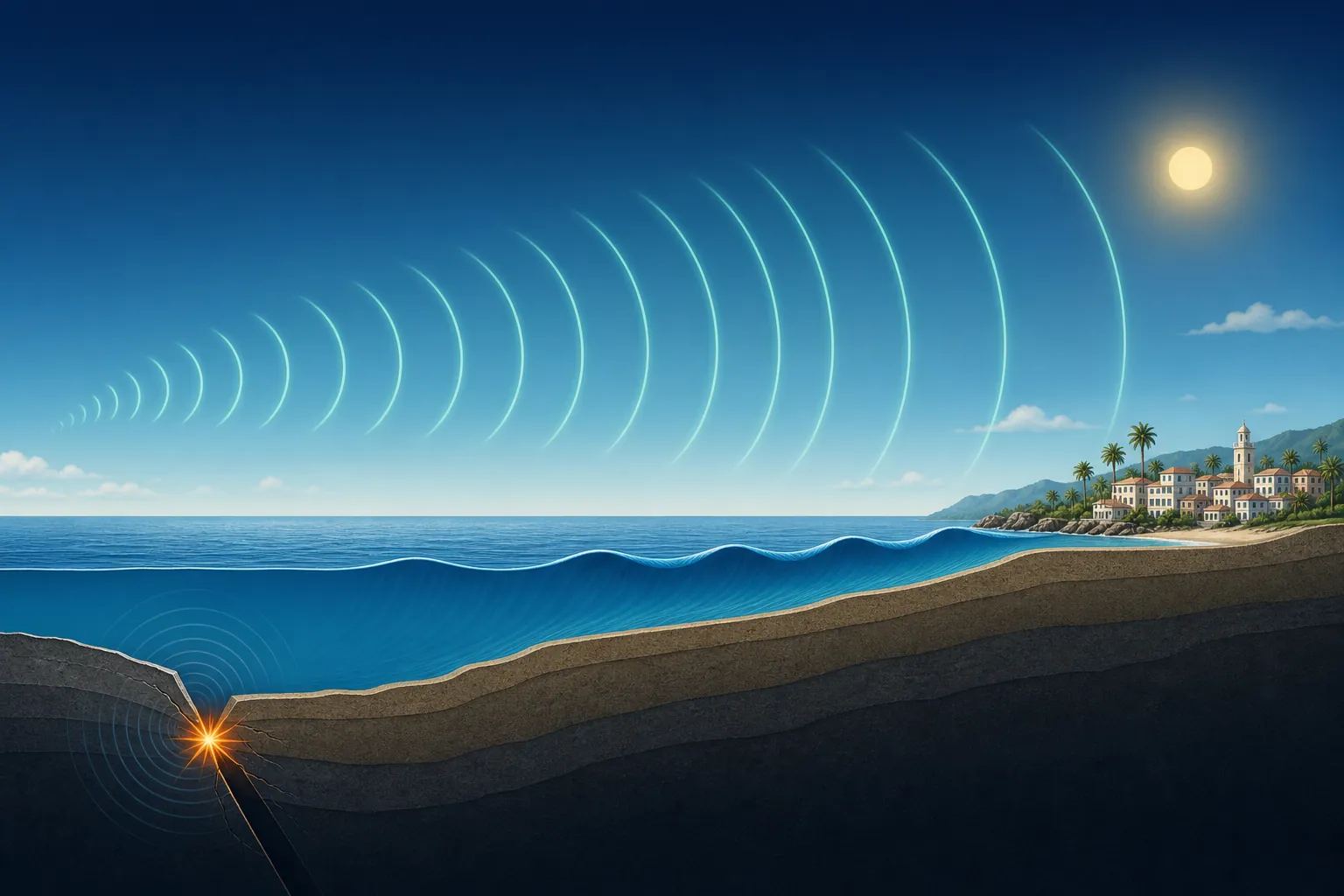
This is not hand-waving theory. After the 2004 tsunami, the team of Alexis Le Pichon showed, using data from the Diego Garcia infrasound station, that the tsunami itself was a source of infrasound waves — the first time in history that their radiation zone, about 1,500 km long, could be reconstructed.
If you need proof that geophysical events literally "sound out" across the whole world — here it is. The eruption of the Hunga volcano (Tonga) on 15 January 2022 produced an atmospheric wave that, according to Science, circled the planet several times over six days. The infrasound from the blast was recorded by all 53 infrasound stations of the international IMS network.
That same atmospheric wave, according to another paper in the same issue of Science, helped tsunami waves reach distant shores earlier than classical models predicted — precisely the "sound outruns the water" effect that HERD is built on.
This is not a legend: elephant "rumbles" have a fundamental frequency of 14–24 Hz in Asian elephants, and these sounds travel both through the air and through the ground. Research by Katy Payne, Caitlin O'Connell-Rodwell and Simon Klemperer has shown that low-frequency elephant vocalisations generate seismic Rayleigh waves that propagate up to ~2 km, and that elephants pick them up with receptors in their feet and trunk.
In field experiments in Namibia, herds of wild elephants were "played" seismic copies of alarm calls — and the elephants reliably changed their behaviour. This was the first demonstration that a large mammal recognises signals transmitted through the ground.
The papers wrote at the time that in Yala National Park (Sri Lanka) not a single dead elephant was found — the animals supposedly sensed the danger and fled to the hills. A beautiful story. But honest science demands verification.
A Smithsonian Institution study of two elephants wearing satellite GPS collars, which on the day of the tsunami were near the impact zone in Yala, showed that neither of them behaved as if it had sensed the wave in advance and run away from the shore. The authors state plainly that the data do not support the "sixth sense" version.
Why do we put this on our own site? Because this is the very essence of HERD: isolated observations of animals are a hypothesis, not proof. The physics of infrasound is firmly established; "animals always sense everything in advance" is not. That is exactly why we are building not a faith in a sixth sense, but a measurable network of instruments that will either catch the signal or honestly show that it did not.
The International Monitoring System (IMS) of the CTBTO is a global network of 60 infrasound stations, originally built to detect nuclear tests. It also catches volcanic eruptions, meteors and explosions. After 2004 the CTBTO received a mandate to pass data directly to national tsunami warning centres.
But 60 stations for the whole planet is a very sparse grid. Our bet is exactly the same as Google's with its smartphone earthquake detector and the Raspberry Shake network: many cheap sensors, combined by correlation, can see what individual expensive instruments cannot. We do not replace professional systems — we densify the picture between them.
A fair sceptic's question: how can you trust a cheap device on someone's balcony? The answer: we don't ask you to. What matters is not "a sensor said so", but dozens of independent nodes recording the same signature in agreement — with the right delays across geography and a bearing toward the source. Random noise or a slamming door cannot line up like that.
So that the data are useful not only to enthusiasts but to insurers and agencies, several layers of verification are built into the architecture itself:
Every link leads to a primary source — peer-reviewed journals, official organisations and quality science journalism. Where possible, a DOI is given.
Peer-reviewed papers and official sources
Peer-reviewedENPeer-reviewed papers
Peer-reviewedENWe include this deliberately
Argues against usEN · PDFOfficial organisations and working networks
OrganisationENThe scientific foundation of the HERD One method: it's been done before — and it worked
Peer-reviewedENPopular-science material on the topic — about infrasound and about how elephants hear the ground.
The science of infrasound is field work. To calibrate sensors next to elephants in sanctuaries and to place stations along coastlines where there is neither a power socket nor a signal, we are building a mobile listening lab on a Toyota Hiace: two sleeping berths for researchers, a workbench with equipment, off-grid power from solar panels and Starlink satellite internet — data goes to the network straight from the wilderness, in real time.
This means reference measurements and node installation are no longer tied to cities and hotels. The lab drives to the source of the signal itself — to the elephants, to the volcano, to the shore.
Then help turn this physics into a network that one day gives the coast ten minutes.
Join — $25