Infrasound is created by any sufficiently large and slow motion: the trembling of the earth, the collision of waves, storm vortices, flows of air. Some sources are natural and constant, some appear for only minutes, some are made by humans. Understanding "who is sounding" matters: to hear a dangerous event, you need to be able to tell it apart from the background chorus.
Natural sources
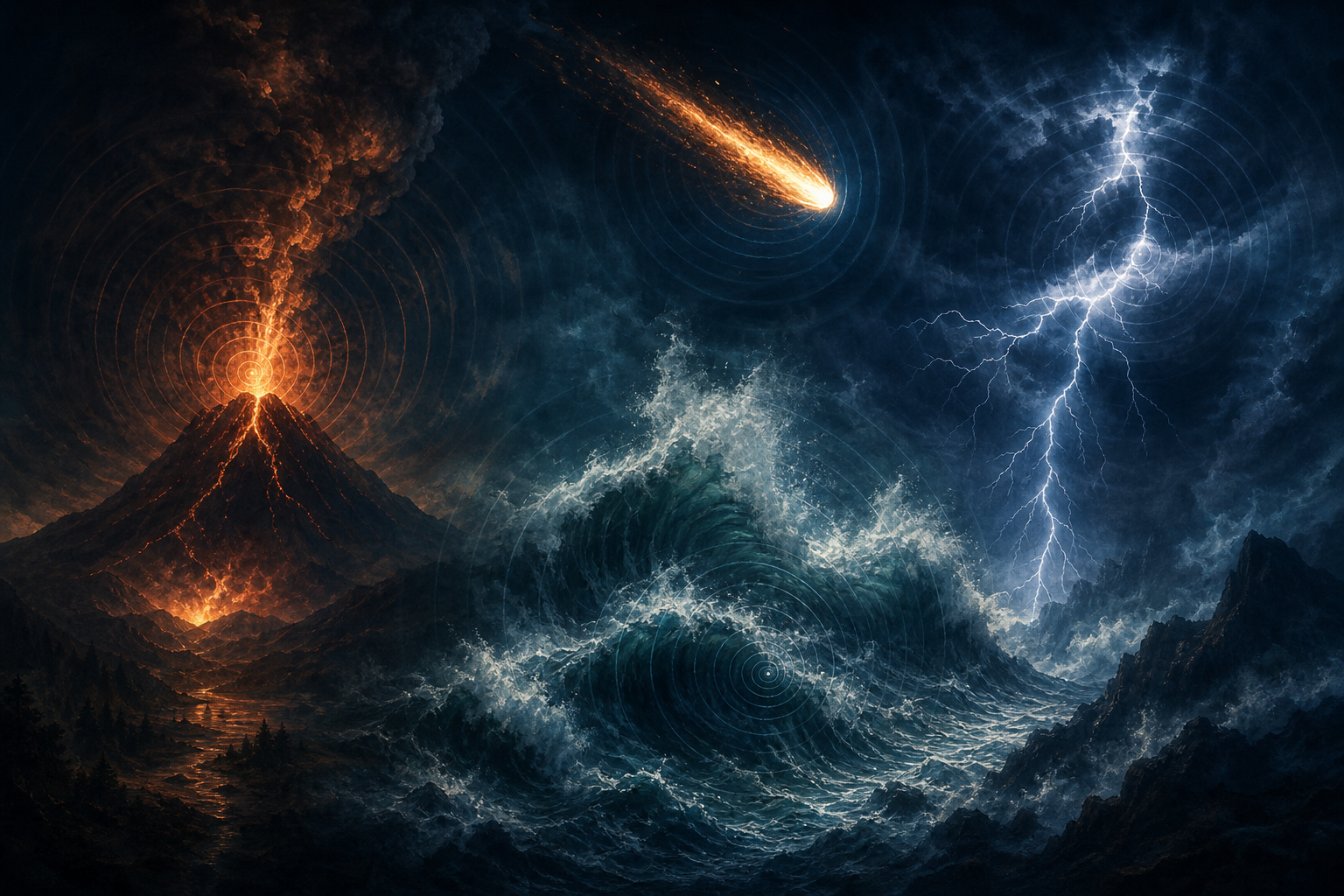
- 🌋Volcanoes and earthquakes. Eruptions are among the most powerful sources; the wave from Hunga Tonga in 2022 was caught by instruments all over the world.1 Tracking volcanoes by infrasound is already a mature discipline.6
- 🌊The ocean. Counter-propagating waves colliding during storms create "microbaroms" — a constant hum around 0.2 Hz.2
- ⛈️Thunderstorms and tornadoes. Strong vortices radiate infrasound, sometimes before a tornado touches the ground.4
- ☄️Meteors. Bolides entering the atmosphere generate powerful shock waves (see Chelyabinsk).3 From the shape of the infrasound signal, the body's energy can be estimated in TNT equivalent.7
- 🏔️Avalanches, waterfalls, wind over mountains. A constant geophysical background.
Anthropogenic sources
Humans are noisy at low frequencies too: quarry blasts, rocket launches, supersonic and ordinary aircraft, large machines, wind turbines and cities as a whole. For monitoring systems this is "interference" that has to be filtered out; for nuclear-test monitoring it is, on the contrary, the target signal.5
All these sources sound at once. Separating a "real event" from the background chorus of ocean, weather and machinery is the central scientific challenge. Arrays of several sensors and algorithms that look at where a wave came from and at what speed help.
- The CTBTO network "hears" rocket launches and large quarry blasts thousands of kilometres away — and can tell them apart from earthquakes.
- Even auroras "sound" in infrasound: pulsating auroras produce high apparent-velocity infrasound recorded in Fairbanks, Alaska (Wilson & Olson, 2005).
- The most constant source on the planet is the ocean: the microbaroms never fall silent.
Our network learns to recognise the "signature" of dangerous events against the planet's constant hum. The better we know the sources, the more precisely we catch what matters.
Sources for this article
These sources are part of the full HERD library — 363 vetted sources, with meaning search and topic filters.
- peer-reviewed Matoza R.S. et al. (2022). Global seismoacoustic observations of the January 2022 Hunga eruption, Tonga. Science 377. science.org
- peer-reviewed Waxler R., Gilbert K.E. (2006). The radiation of atmospheric microbaroms by ocean waves. JASA 119(5). pubs.aip.org
- peer-reviewed Le Pichon A. et al. (2013). The 2013 Russian fireball largest ever detected by CTBTO infrasound sensors. GRL 40. agupubs.wiley.com
- peer-reviewed Bedard A.J. (2005). Low-frequency atmospheric acoustic energy associated with vortices produced by thunderstorms. Mon. Wea. Rev. 133(1). journals.ametsoc.org
- review Bedard A.J., Georges T.M. (2000). Atmospheric Infrasound. Physics Today 53(3). physicstoday.aip.org
- peer-reviewedreview Fee D., Matoza R.S. (2013). An overview of volcano infrasound: from Hawaiian to Plinian, local to global. J. Volcanol. Geotherm. Res. 249. doi.org
- peer-reviewed Edwards W.N., Brown P.G., ReVelle D.O. (2006). Estimates of meteoroid kinetic energies from observations of infrasonic airwaves. J. Atmos. Sol.-Terr. Phys. 68. doi.org
- peer-reviewed Wilson C.R., Olson J.V. (2005). High trace-velocity infrasound from pulsating auroras at Fairbanks, Alaska. GRL 32. doi.org
- review Johnson J.B., Ripepe M. (2011). Volcano infrasound: A review. Journal of Volcanology and Geothermal Research 206(3-4). doi.org
- review Silber E.A., Boslough M., Hocking W.K., Gritsevich M., Whitaker R.W. (2018). Physics of meteor generated shock waves in the Earth's atmosphere - A review. Advances in Space Research 62(3). doi.org
- peer-reviewed Mutschlecner J.P., Whitaker R.W. (2005). Infrasound from earthquakes. Journal of Geophysical Research: Atmospheres 110(D1). doi.org
- peer-reviewed Farges T., Blanc E. (2010). Characteristics of infrasound from lightning and sprites near thunderstorm areas. Journal of Geophysical Research: Space Physics 115(A6). doi.org
- history ReVelle D.O. (1976). On meteor-generated infrasound. Journal of Geophysical Research 81(7). doi.org
- review Campus P., Christie D.R. (2010). Worldwide Observations of Infrasonic Waves. In: Infrasound Monitoring for Atmospheric Studies (Springer). doi.org
- peer-reviewed Gi N., Brown P. (2017). Refinement of bolide characteristics from infrasound measurements. Planetary and Space Science 143. doi.org
HERD (2026). What creates infrasound. HERD — Infrasound library. https://theherd.network/infrasound/en/sources